

AI SEO is the work of getting your business named inside an AI answer instead of ranked in a list of links. We tested 151 top-rated Australian tradies and 84% were never named. Here is the definition, the proof, and what Google's own guide says you do not need.
AI SEO is the work of getting your business named or cited inside an AI answer, in ChatGPT, Google's AI Overviews and AI Mode, Gemini, Perplexity or Claude, rather than ranked in a list of links a customer still has to click through.
It is not "using AI tools to do your SEO". That is the other thing people mean by the phrase, and the confusion is real enough that the top-ranking page for this query is a Reddit thread whose author writes that "everyone seems to explain it differently. Some people say it's just using AI tools, others...". Both meanings are in circulation. Only one of them decides whether a customer ever hears your name.
This page gives you three things the other results on this query do not have: a test of 151 top-rated Australian tradies that shows what AI answers actually reward, a record of which pages four engines read before they named anyone, and Google's own July 2026 guidance, which contradicts a fair amount of what gets sold as AI SEO. Orkkid is an AI SEO agency and we sell AI SEO services, so read this with that in mind. Every number below has a source you can open.
TL;DR
- AI SEO means being named or cited in an AI answer. The other meaning, using AI tools to produce SEO work, is a workflow question, not a channel.
- It is not the same game as ranking. In our Q3 2026 study of 151 top-rated Australian tradies, only 24 (15.9%) were ever named by AI. Sydney plumbers and electricians: 0 of 16.
- Star ratings barely separated them. Named businesses averaged 4.89 stars and 311 reviews, unnamed 4.81 and 331. Ninety-nine per cent of the unnamed had a website.
- The engines read third-party pages. In our 17 September 2026 panel, ChatGPT built 13 of 20 local answers on one aggregator listicle, and Perplexity cited Localsearch in 13 and Reddit in 12.
- Google's guide (updated 10 July 2026) says you do not need special schema, AI text files, content chunking or a special writing style, and that Google Search ignores llms.txt files.
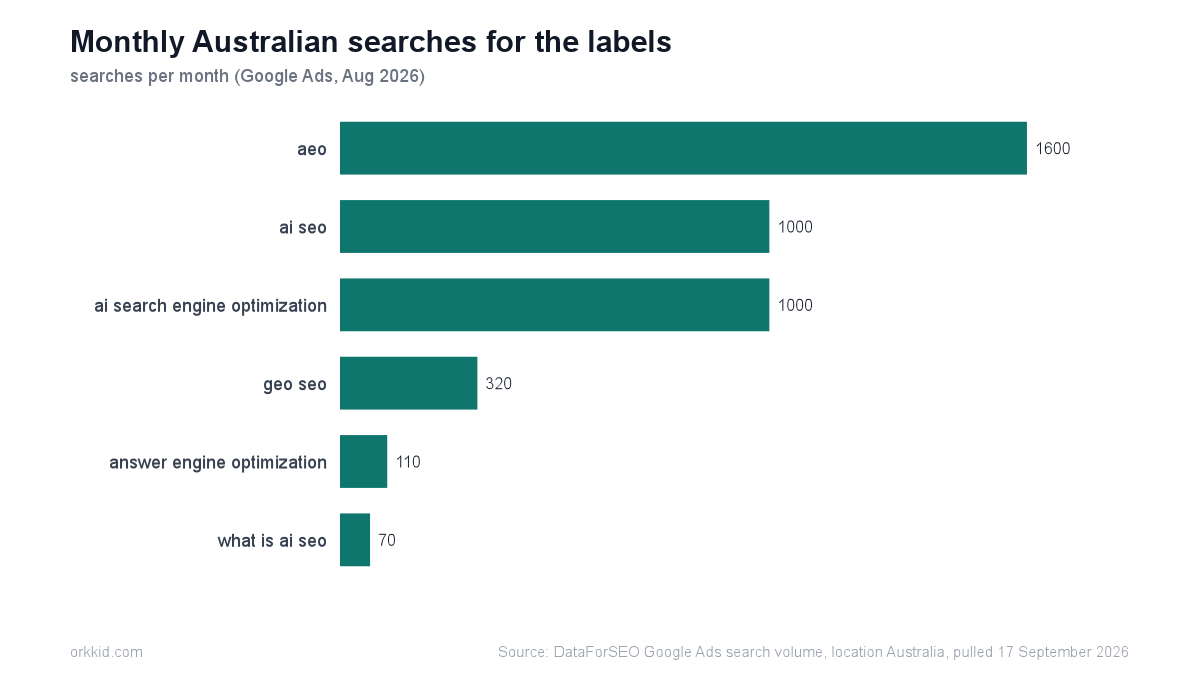
- Australians search "aeo" 1,600 times a month and "ai seo" 1,000 times. The name keeps moving. The work does not.
What is AI SEO? Two meanings, and the one that pays
AI SEO is optimising your business so that AI search tools name, cite or recommend you in the answer they write. Search Engine Land's guide puts it as "the process of making your content discoverable, extractable, and trusted across AI-powered search experiences" (updated 30 December 2025). Google's own AI Overview for this exact query in Australia on 17 September 2026 defined it as optimising your website so that AI-powered search tools will "cite your brand in their direct answers", and added that it "is also known as Answer Engine Optimization (AEO) or Generative Engine Optimization (GEO)".
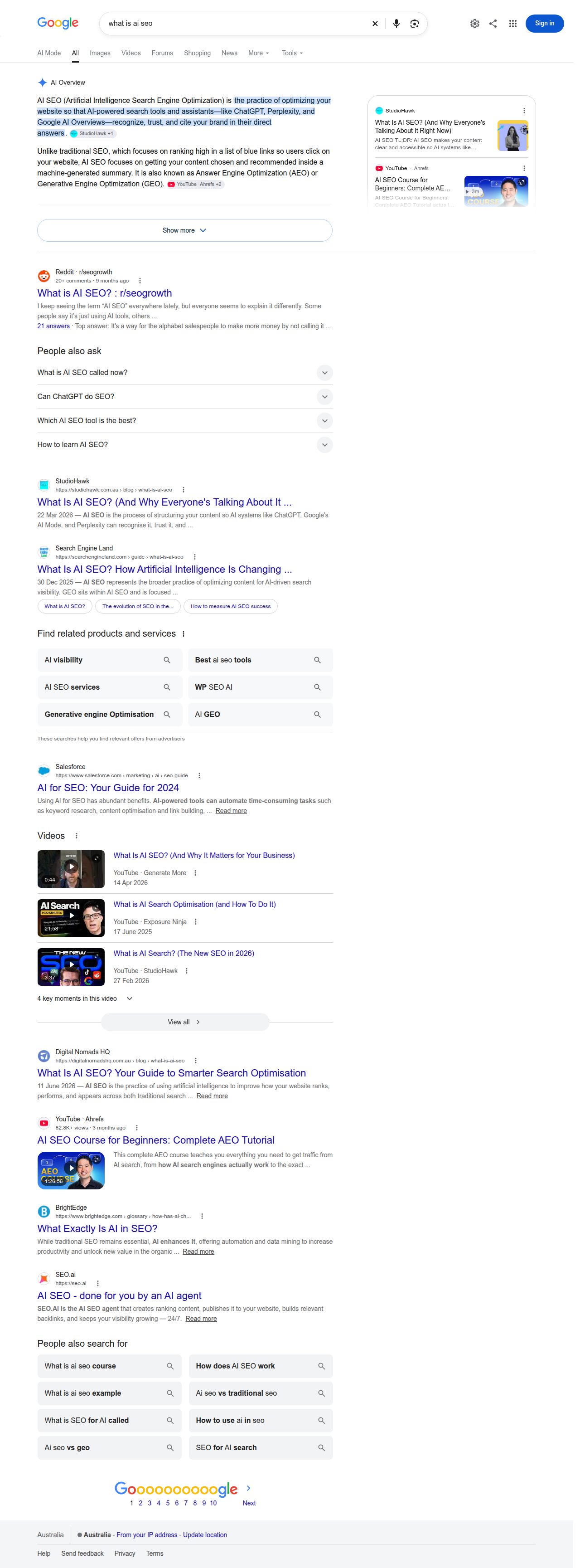
The second meaning is using AI tools to do SEO tasks: drafting briefs, clustering keywords, writing meta descriptions, generating first drafts. That is a production question, and a reasonable one, but it is not a channel and it does not change who gets recommended. A business can use every AI writing tool on the market and still never appear in a single answer. When someone sells you "AI SEO" and only talks about content velocity, they are selling you the second meaning.
For the rest of this page, AI SEO means the first one: getting named. The method has a formal name, Answer Engine Optimisation, and a second one, Generative Engine Optimisation. Same work, different labels, which we come back to below.
AI SEO vs traditional SEO: same foundations, a different finish line
Traditional SEO competes for a position in a list. AI SEO competes for a slot inside a written answer, where there are usually three to five names and no page two. The underlying work overlaps heavily, which is why nobody should treat these as rival budgets.
| What changes | Traditional SEO | AI SEO |
|---|---|---|
| The win | A ranked link a customer clicks | Your name inside the answer |
| Slots available | Ten organic positions, plus a map pack | Three to five businesses, typically |
| What decides it | Your pages, links, relevance | What third-party pages say about you |
| Where you are judged | Your own site | Listicles, directories, Reddit, your site |
| Measurement | Rankings, clicks, impressions | Named or not named, per prompt |
| Feedback speed | Weeks to months | Same day, but answers vary between runs |
The last row matters more than it looks. Rankings are stable enough to chart. AI answers are not: ask the same question twice and you can get two different lists. That is why AI SEO measurement counts how often you are named across a fixed set of prompts, not where you sit on a single day.
Our 151-tradie test: being top-rated did not get them named
Being the highest-rated business on Google Maps did not make AI name you. We pulled 151 top-rated tradies from Google Maps across 20 city and trade combinations, asked AI who to call in each one, and counted. Twenty-four were named. That is 15.9%. In Sydney, across plumbers and electricians, the count was 0 of 16.
The detail is where it stops being a slogan. Here is how the named and the unnamed compared on the things owners usually work hardest on.
| Measure | Named by AI (24 businesses) | Never named (127 businesses) |
|---|---|---|
| Average Google rating | 4.89 stars | 4.81 stars |
| Average review count | 311 | 331 |
| Had a website | 92% | 99% |
| Claimed Google profile | 100% | 100% |
Read that table twice. The unnamed group had more reviews on average and was more likely to have a website. Every business in the study had a claimed profile and a strong rating, because that is how they were selected. So the thing that separated the 24 from the 127 was not the classic local SEO scorecard at all.
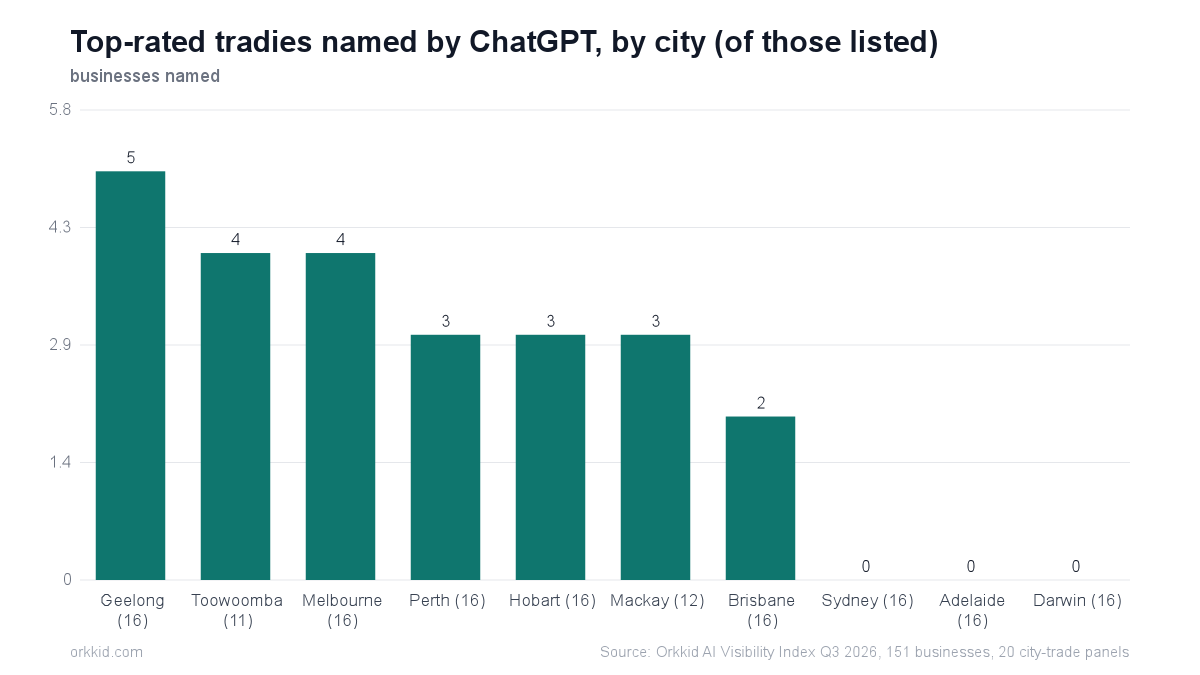
City made more difference than merit. Geelong returned five named businesses across its two panels and Toowoomba four, while Sydney, Adelaide and Darwin returned none at all. Bigger market, more competing pages, fewer clean lists for the engine to lean on. The full method, the per-city breakdown and the raw counts are in our AI visibility study of 151 Australian tradies. One caveat we will repeat: that study asked ChatGPT only.
84% of top-rated roofers are invisible to AI. Are you?
One report: who AI recommends in your suburbs right now, what they have that you don't, and the fastest path to being the name it gives. Sent within 72 hours.
Get the free AI audit →What the engines read before they name a business
They read other people's pages. On 17 September 2026 we ran the same 20 "who should I call" prompts across four engines with web search on, then recorded every source each answer cited. The pattern was consistent enough to plan around.
| Engine | What it leaned on across 20 local prompts | What that means for you |
|---|---|---|
| ChatGPT | One aggregator listicle with star ratings in 13 of 20 answers (Starworks, Birdeye, Home Done, ChiroHub) | Get onto the "best X in city" lists, with a rating |
| Gemini | The business's own website in 19 of 20 answers, Reddit in 6 | A plain, readable site is doing real work here |
| Perplexity | Localsearch in 13 of 20, Reddit in 12, Hipages in 9 | Directory profiles and community threads decide it |
So AI SEO, in practice, is mostly this: be present on the Australian pages the engines fetch (Localsearch, Hipages, Oneflare, Word of Mouth, Birdeye, Starworks, Home Done), carry a visible rating on them, keep a plain website that states what you do and where, and earn the occasional real mention in a community thread.
Each engine decides when and how to fetch, and they do not share a rulebook. OpenAI documents how ChatGPT's web search tool retrieves and cites sources. Anthropic's documentation says Claude "determines when to search based on the prompt". Google publishes how Gemini grounds answers in Search, and Perplexity documents how a user's location shapes what it retrieves. Four retrieval systems reading one open web. Which is why the work is about the pages, not about pleasing one engine.
What Google says you do not need for AI SEO
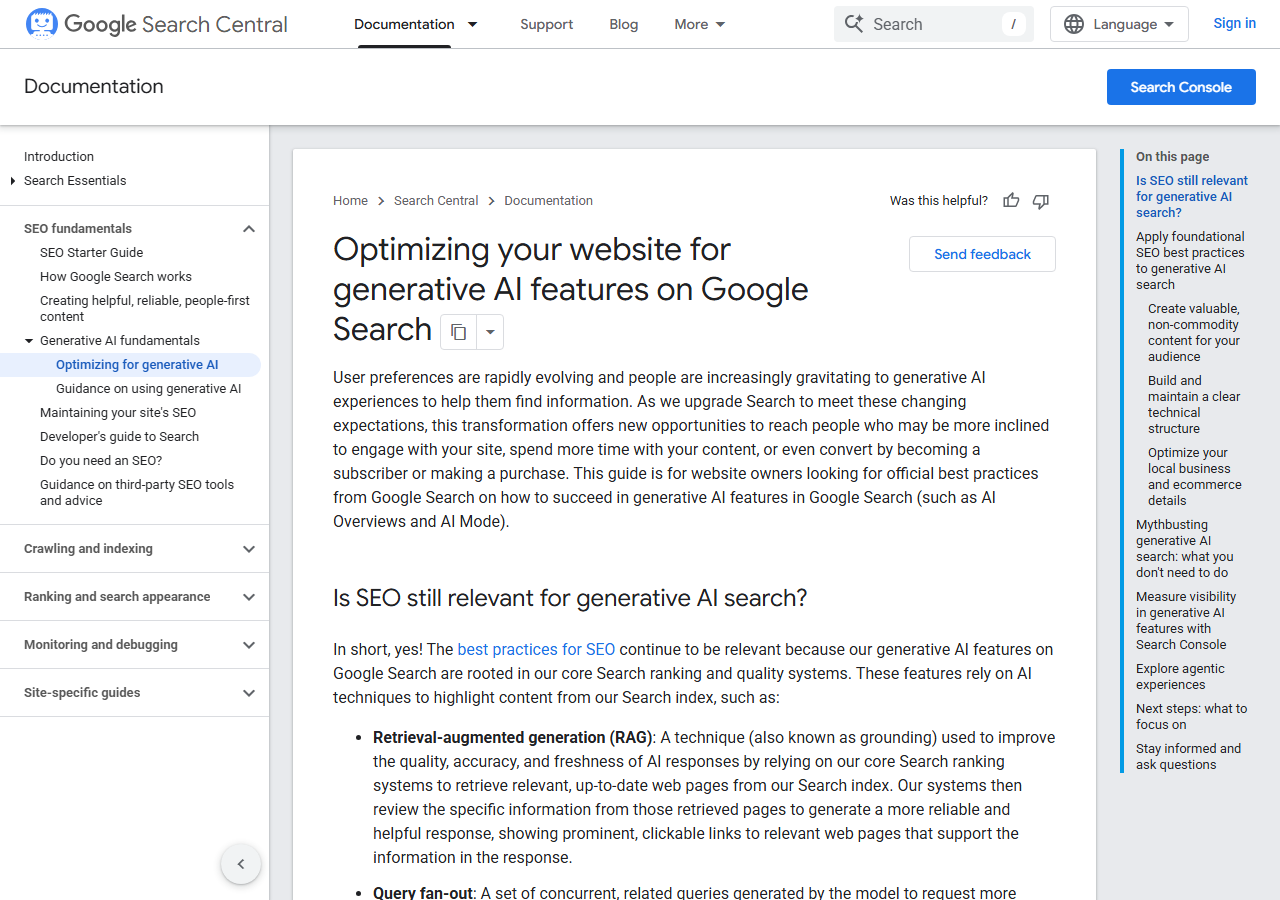
Quite a lot of it. Google updated its guide to generative AI features in Google Search on 10 July 2026, and its mythbusting section removes several things that get sold as AI SEO deliverables. The headline: "In short, yes! The best practices for SEO continue to be relevant because our generative AI features on Google Search are rooted in our core Search ranking and quality systems."
| What Google's guide says (10 July 2026) | What still gets sold as AI SEO |
|---|---|
| "there's no special schema.org markup you need to add" | AI-specific schema packages |
| "Structured data isn't required for generative AI search" | Schema as the AI ranking lever |
| No need to "create new machine readable files, AI text files, markup, or Markdown" | AI text files as a must-have |
| On llms.txt files: "Google Search ignores them" | llms.txt as a Google ranking factor |
| "There's no requirement to break your content into tiny pieces" | Chunking every page for retrieval |
| "You don't need to write in a specific way just for generative AI search" | A special AI writing style |
Read the whole thing at Google's guide to generative AI features in Google Search. It also has sections on getting your local business and product details right, and on measuring how you appear in generative AI features through Search Console, which is the practical half most summaries skip.
Now the honest caveat, twice over. First, that guide covers Google Search only. ChatGPT, Perplexity and Claude retrieve differently, as the vendor documentation above shows, so "Google ignores it" is not the same as "no engine reads it". Second, that caveat includes our own advice. We publish an llms.txt file on orkkid.com for the non-Google engines, and we will keep publishing it, because it takes about ten minutes and costs nothing to maintain. But it is a cheap bet, not a ranking factor: Google has now told you plainly that it ignores them, and no other engine has published a commitment to read them. If you have read our beginner's guide to llms.txt, read it next to Google's line and weight it accordingly. Our free AI visibility audit scores an llms.txt file as part of its checklist for the same reason, and the same discount applies to that part of the score.
If a proposal you are reading spends its first three deliverables on schema, llms.txt and chunking, you now have Google's own words to ask about.
AEO, GEO, LLMO: the labels, and what Australians actually search
They are labels for the same work, and "AEO" is currently the one Australians type most. Google Ads data for Australia, pulled 17 September 2026, puts "aeo" at 1,600 searches a month, "ai seo" and "ai search engine optimization" at 1,000 each, "geo seo" at 320, "answer engine optimization" at 110, and "what is ai seo" at 70. These are Google Ads estimates, so treat them as a shape, not a census.
The trend line is worth a glance too, because it tells you the category is holding rather than exploding.
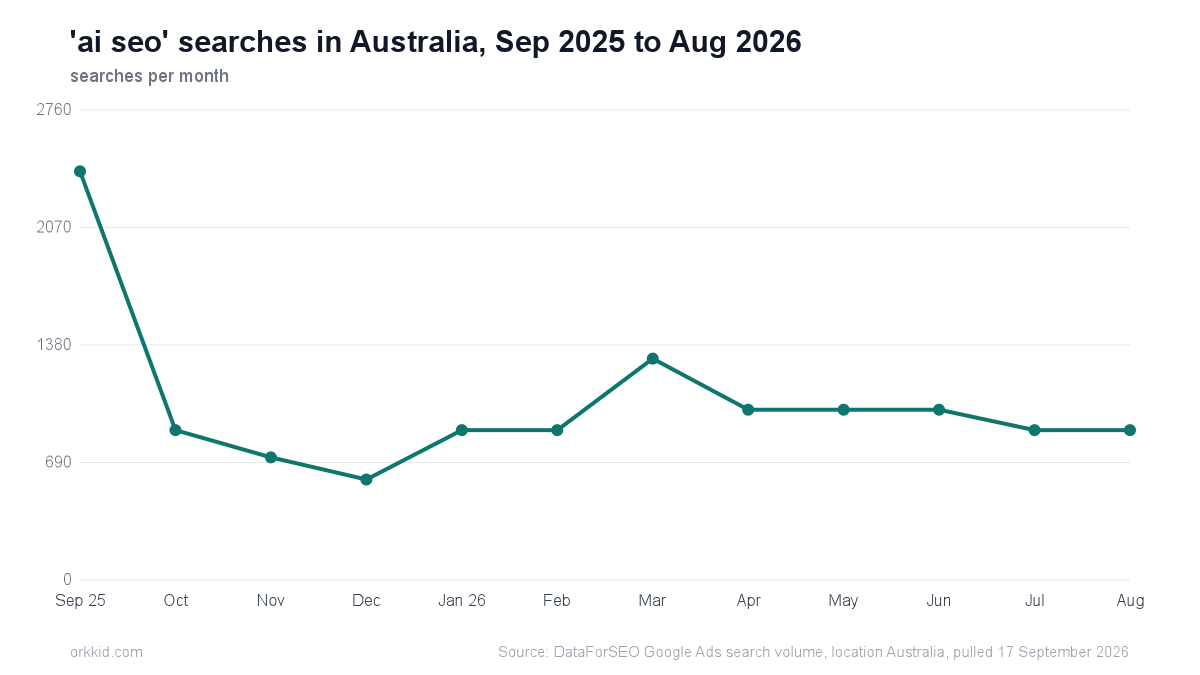
"ai seo" spiked at 2,400 in September 2025, fell to 590 by December, recovered to 1,300 in March 2026 and has sat between 880 and 1,000 ever since. A category with a stable floor, not a fad and not a gold rush.
We use AI SEO as the umbrella term and AEO as the name of the method inside it. LLMO turns up occasionally and means the same thing again. None of the labels change a single task on the list. If you want the distinctions drawn properly, our comparison of AEO, GEO and AI SEO is the page for that; this one is the definition and the evidence behind it.
How to do AI SEO for a service business, in order
Start with the pages the engines actually read, not with your own website. Ordered by what moved the needle in our data, with honest time estimates:
- Get your Google Business Profile complete and the primary category exact (60 to 90 minutes). Go to Google Business Profile > Edit profile > Business category and check the primary against what customers call the job, not what you call it. Services, hours, service areas and photos all filled. Our Google Business Profile checklist has the full field list.
- Claim and complete the aggregator and directory profiles the engines cite (2 to 3 hours). Localsearch, Hipages, Oneflare and Word of Mouth at minimum. A profile with no rating on it is close to useless, so ask for reviews there as well as on Google.
- Get onto the "best trade in city" lists (ongoing). These are what ChatGPT built 13 of 20 answers from. Most accept submissions or enquiries. It is unglamorous outreach and it is the highest-return hour in this list.
- Publish one plain page per service, naming your suburbs (2 hours per page). Plain headings, a direct first sentence, price ranges if you can, and the suburbs written out. Gemini cited business websites in 19 of 20 answers, and it can only cite what it can read.
- Earn one real community mention (varies). Reddit appeared in 12 of Perplexity's 20 answers and 6 of Gemini's. Be genuinely useful in a local subreddit or a suburb Facebook group. Do not astroturf; it gets found and it reads badly.
- Keep your name, address and phone identical everywhere (1 hour, then quarterly). Mismatches split you into two half-businesses in the engines' view.
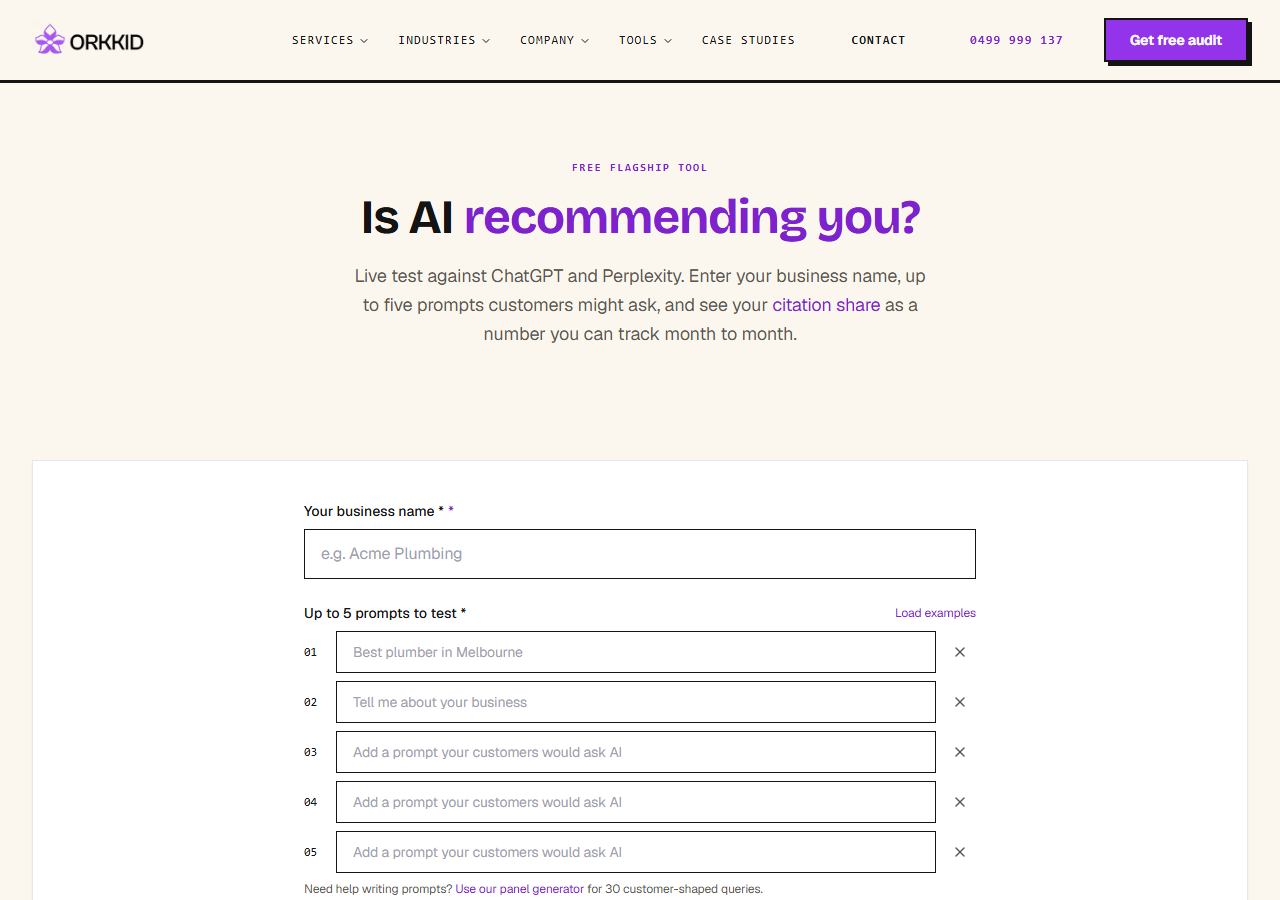
- Measure monthly against a fixed prompt panel (30 minutes a month). Write down ten questions a customer would actually ask, run them, record whether you were named. Our free AI citation checker does this for five questions across ChatGPT and Perplexity.
Do those seven and you have done more than most of your competitors will do this year. If you want them sequenced into a schedule with owners and checkpoints, follow the 30-day AEO launch playbook.
Be the roofing business AI recommends
We tested 151 top-rated Australian tradies and 84% were never named by ChatGPT. Check your roofing business before your competitor checks theirs.
Tested: 151 top-rated Australian tradies · 15.9% named by ChatGPT · Q3 2026 study
Get the free AI audit →FAQ
What is AI SEO called now?
AI SEO, AEO and GEO are all current, and they describe the same work. In Australian Google Ads data pulled on 17 September 2026, "aeo" gets about 1,600 searches a month, "ai seo" about 1,000 and "geo seo" about 320. Google's own AI Overview says AI SEO is also known as Answer Engine Optimization or Generative Engine Optimization. Pick one label and be consistent.
Is SEO dead now with AI?
No. Google's guide, updated 10 July 2026, states that SEO best practices "continue to be relevant because our generative AI features on Google Search are rooted in our core Search ranking and quality systems". The engines also read ordinary web pages: directories, listicles, forum threads and business websites. AI changed where you get chosen, not what gets crawled.
Can ChatGPT do SEO?
It can help you do SEO tasks, and that is the second meaning of AI SEO. It will draft briefs, cluster keywords and write outlines. It will not claim your directory profiles, collect your reviews or get you onto the lists that other engines cite. Treat it as a fast assistant for the production work, not as the channel itself.
How does AI SEO work?
Engines answer a question by fetching pages and summarising them, so whether you are named depends on whether you appear on the pages they fetch. In our 17 September 2026 panel, ChatGPT leaned on aggregator listicles with star ratings in 13 of 20 local answers, Gemini cited the business's own website in 19 of 20, and Perplexity cited Localsearch in 13.
Do I need llms.txt or special schema for AI SEO?
Not for Google. Its July 2026 guide says "there's no special schema.org markup you need to add" and that Google Search ignores llms.txt files. Other engines retrieve differently and publish no equivalent statement, so an llms.txt file remains a cheap, low-confidence bet. Do it after the profile, directory and content work, never instead of it.
Which AI SEO tool is the best?
No tool gets you named; tools tell you whether you are. What you need first is a measurement tool that runs a fixed set of customer questions across engines and records the result, so you can tell whether anything you changed worked. Ours is free and covers five questions across ChatGPT and Perplexity. The rest of the work happens off the dashboard.