

You cannot delete someone else's Google review, and neither can anyone you pay. You can get Google to remove it when it breaks a content policy. Here is the policy matrix, the three report paths with the exact button names, the one-time appeal, and what Australian law actually allows.
You cannot delete someone else's Google review. Neither can anyone you pay. The only thing that removes a review is Google deciding the review breaks one of its content policies, and the only question that matters on the morning you find a one-star from a person you have never met is this: which policy line does it break, and can you prove it from the outside?
This page answers it in a table: twelve kinds of review an owner actually sees, each mapped to the policy Google applies, how provable it is, and what to do when the report fails. Then the three report paths with the exact button names, the statuses and the one-time appeal, and the part no other page on this search covers: what the ACCC says about removing genuine negative reviews, and what Australian law now asks of a small business before it sues over a one-star.
We sell AI SEO services. We do not sell review removal, which is worth knowing when you read the section on removal firms. If the review is genuine and simply bad, you are on the wrong page: our guide to replying to Google reviews is the playbook for that, and this one is only about getting a review taken down.
TL;DR
- Business owners cannot delete a review. Google removes reviews only for policy violations, and "I disagree with it" is not one.
- Match the review to a policy line first: fake engagement, conflict of interest, off topic, harassment, personal information, paid reviews or repetitive content. Report against that line, not against the sentiment.
- Three paths: your Business Profile, the Reviews Management Tool, and the Merchant Extortion Report Form when a one-star wave arrives with a demand for money.
- Evaluation "typically takes several days". You get one appeal per reported review, capped at 10 reviews per appeal, so do not spend it without new evidence.
- The ACCC treats suppressing or editing genuine negative reviews as potentially misleading conduct. Meriton paid $3 million and HealthEngine $2.9 million for versions of that.
- When Google says no, the public reply is the only lever you fully control, and the arithmetic is kinder than it feels: one 1-star on a 4.8 average from 50 reviews takes you to 4.73.
Can you remove a Google review in Australia?
Not directly, and no Australian rule changes that. Google decides what stays up, and it removes a review only when the content breaks one of its user contribution policies. Australian law can force Google's hand in narrow cases through a legal request, which is a separate process from a policy report, but no consumer-protection route makes a platform delete criticism of your business.
Google's own help page is blunt about the line: "Do not report a review just because you disagree with it or dislike it. Google doesn't get involved in conflict between businesses and customers." That sentence sits on the report inappropriate reviews page and it is the reason most reports fail. Owners report the feeling. Google assesses the content.
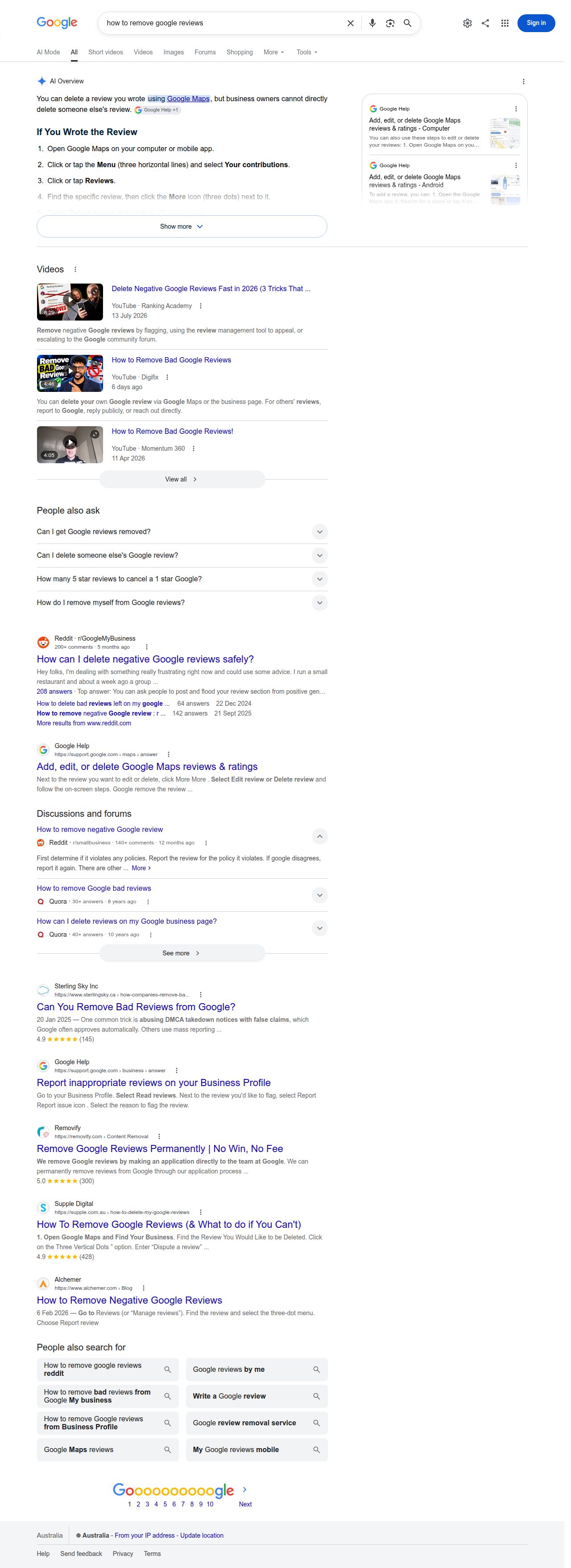
Google Australia, September 2026. Even the AI Overview leads with the limit: you can delete a review you wrote, but you cannot delete someone else's.
How to delete a review you wrote yourself
If the review is one you left on another business, you can delete it in seconds. Open Google Maps, tap the menu, then Your contributions, then Reviews, find the review, tap More, then Delete review. That is the only "delete" button Google gives anyone, and it belongs to the person who wrote the words.
Which reviews Google will remove: the policy matrix
Google removes reviews that break a named policy, so your report succeeds or fails on which line you cite and how visible the breach is from the outside. The categories come from Google's user contribution policies: fake engagement is content "that is not based on a real experience or does not accurately represent the location"; conflict of interest "may include current or former employment, a contractual or consultory relationship"; off topic bans "general, political, or social commentary or personal rants"; harassment covers "a specific threat of harm" and publishing personal information; paid reviews are those "paid for, directly or in kind".
Google's flag menu wording shifts over time, so pick the reason closest to the policy in this table, then use the description box to quote the policy line and name your evidence.
| Review in front of you | Policy line to cite | How provable from outside | If the report fails |
|---|---|---|---|
| Person who was never a customer | Fake engagement | Medium. Your job records are the evidence | Reply that you have no record of the job |
| Competitor posing as a customer | Fake engagement, conflict of interest | Low, unless the account only reviews your rivals | Reply calmly, screenshot it, watch for a pattern |
| Ex-employee or their family | Conflict of interest | Medium. Names and dates often show on the account | Reply once, never argue employment in public |
| Review meant for a different business | Misrepresentation | High. It names another trade, brand or suburb | Ask the reviewer to move it, then report again |
| Politics or a rant about your industry | Off topic | High. Nothing in it describes your service | One-line reply, do not engage the topic |
| One-star wave, then a demand for money | Extortion | High if you keep the messages | Merchant Extortion Report Form, and never pay |
| Your home address or a staff surname | Personal information | High. The text speaks for itself | Report again quoting the exact line |
| Threats or abuse aimed at a person | Harassment | High. A specific threat of harm is explicit | Report, then consider police if threats continue |
| Review bomb after a news story | Fake engagement, off topic | Medium. Timing and volume are the evidence | Report the worst few, reply once, wait it out |
| A rival's incentivised five-star reviews | Paid reviews | Low, unless the offer was posted publicly | Report on their profile, keep the evidence |
| Same person reviewing you repeatedly | Unclear and repetitive content | High. Duplicates are visible on their profile | Report each duplicate separately |
| One-word one-star, no detail | None. Not a violation | Not applicable | Reply, then go and earn newer reviews |
Two things fall out of that table. Most genuinely unfair reviews sit in the low-provability rows, which is why owners feel ignored. And Google does remove at volume when the breach is machine-visible.
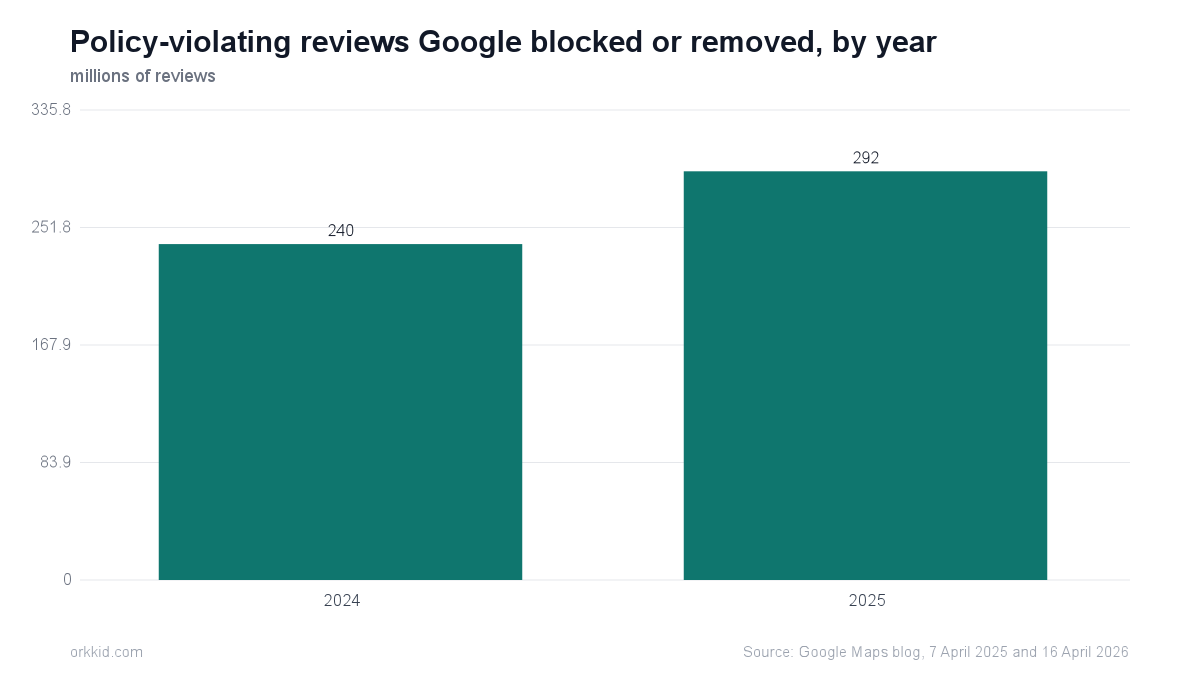
Google's own enforcement numbers. The removals happen at scale, but they happen against policy lines, not against unfairness.
Get your free local AI SEO audit
We test the real questions your customers ask across ChatGPT, Perplexity and Google AI, then show you which local businesses get named instead of you and what it takes to change that. Free, no pitch.
Check my AI visibility →How to report a fake Google review: the three paths
Three paths, and they are not interchangeable: the profile path for a single review, the Reviews Management Tool when you want a tracked status, and the extortion form when a one-star wave comes with a demand for money. Pick the right one first time, because a duplicate report does not add weight.
Path 1: from your Business Profile
Go to your Google Business Profile, select Read reviews, find the review, select Report next to it, select the reason to flag the review, then select Send report. Fastest path, and the right one for a single obvious breach: an off-topic rant, a review naming a different business, a review that publishes personal information.
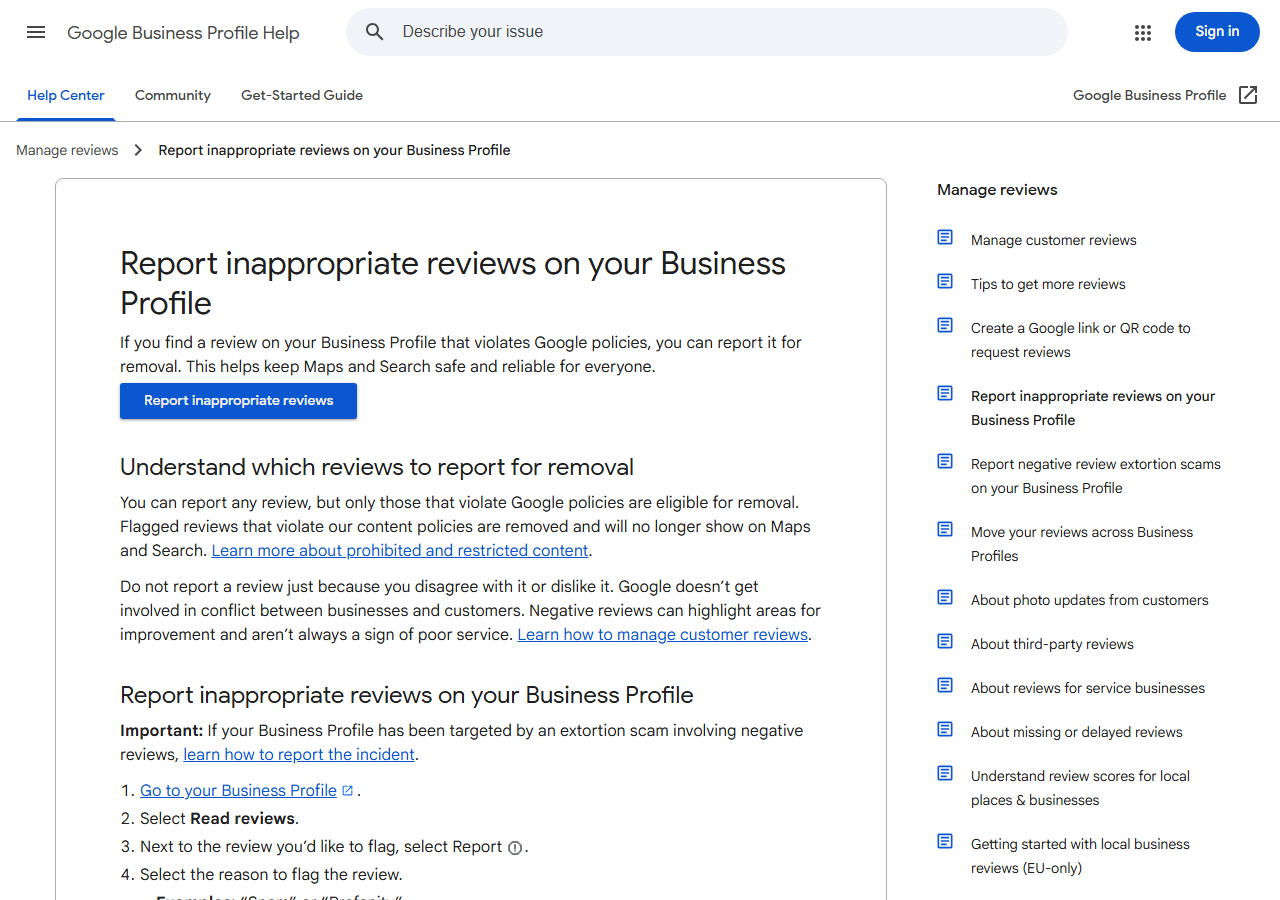
Google's report page: the Read reviews to Report path, the Reviews Management Tool, and the statuses you will see afterwards.
Path 2: the Reviews Management Tool
Open the Reviews Management Tool, select Confirm, select the business, select Continue, then Report a new review for removal, then Report, choose the reason and Submit. Use it when you want a record: it shows the status of everything you have reported, which the profile path does not, and it is where the appeal lives.
Path 3: the Merchant Extortion Report Form
Google runs a separate process for the pattern where a business gets "a sudden increase in 1-star and 2-star reviews ... followed by someone demanding money, goods, or services in exchange for removing the negative reviews". You report it through the Merchant Extortion Report Form on Google's negative review extortion page, attaching screenshots, links to the reviews, the handles the demands came from and a timeline.
Follow Google's instruction on that page before anything else: "Do not engage with or pay the malicious individuals." Paying marks you as a business that pays.
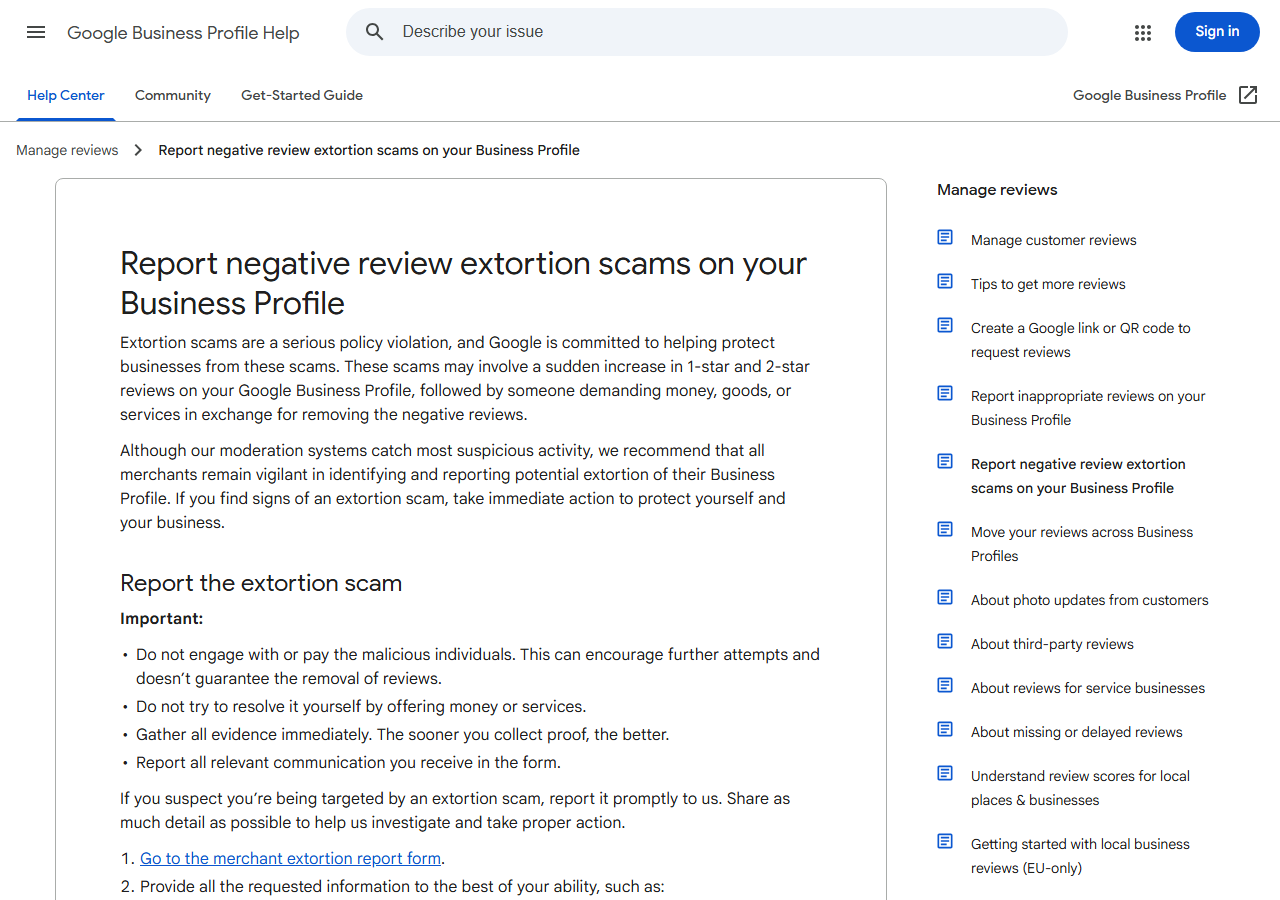
The extortion path is separate from an ordinary report, and it is the one to use when a one-star wave arrives with a demand attached.
What the report statuses mean and how the one-time appeal works
Google gives you three statuses, one timeframe and one appeal. Evaluation "typically takes several days", and the appeal is exactly that: one per reported review, with a maximum of 10 reviews per appeal, so it is worth saving until you have something new to say.
| Status Google shows | What it means | Your next move |
|---|---|---|
| Decision pending | Still being assessed, usually for several days | Wait. Re-reporting does not speed anything up |
| Report reviewed, no policy violation | Google read it and the review stays up | Appeal once, with new evidence, or reply publicly |
| Escalated, check your email for updates | A person is now looking at it | Watch that inbox and reply in the same thread |
The appeal sits behind "Check the status of a review I reported previously and appeal options" in the Reviews Management Tool. A good appeal adds a fact the first report did not have: the account reviewed four of your competitors in one week, the review names a suburb you do not service, the reviewer is a former employee whose end date you can state. An appeal that repeats "this is unfair" spends your one shot for nothing.
If a review is defamatory rather than policy-breaking, that is a different door. Google assesses legal removal requests separately from policy reports through its Report Content for Legal Reasons troubleshooter. A legal request is not a faster policy report, and filing one does not improve the odds of the report you already lodged.
Removal services, defamation letters and the ACCC
Before you pay anyone: no service can delete a Google review, so every removal firm is filing the same policy reports and legal forms you can file yourself, or doing something you would not want your profile associated with. That is the whole market in one sentence.
What "no win, no fee" removal actually buys
Labour and persistence: matching each review to a policy line, writing the reports, filing legal requests where a review is genuinely defamatory, and chasing appeals. That has value if you have 30 fake reviews and a business to run. The part to ask about is method. If a firm will not name which policy line it will cite and which form it will file, assume the method is one that gets reversed later, such as misrepresenting a complaint to force a takedown. The reviews come back, and the profile carrying the risk is yours, not theirs. "Guaranteed removal" is the clearest tell, because the decision belongs to a platform that says in writing that it stays out of disputes between businesses and customers.
Defamation: the serious harm question
Suing over a one-star review is harder than it sounds, and the reason is the serious harm element added to Australian defamation law by the uniform reforms. Summarising section 10A of the Defamation Act 2005 (NSW), the Law Society Journal explains that serious harm to reputation is now an element the plaintiff must establish, that for an "excluded corporation" (broadly, a small business) harm is not regarded as serious unless it has caused or is likely to cause serious financial loss, and that a judge decides the question. Its example of how that bites is Scott v Bodley [2022] NSWDC 459, where a small painting business could not show serious harm from a one-star review.
Take that as a general picture rather than advice: each state and territory has its own Act, so the wording that matters is the one in your jurisdiction. A lawyer's letter earns its cost when the review makes a specific false factual allegation and you can point to lost contracts. It is money burned on a rude opinion about your price.
What the ACCC actually prohibits
The ACCC's position runs opposite to most owners' instincts: the risk is not failing to remove reviews, it is removing the wrong ones. Its guidance states that "it's against the law for a business to create fake or misleading reviews or to arrange for others to do so", and that businesses can mislead consumers when they "suppress or edit negative reviews" or "remove genuine reviews that are negative". So a five-star wall with no critical reviews is a compliance risk, not a trophy.
The ACCC's online reviews guidance, the page most removal pitches never mention.
The penalties are not theoretical. Meriton paid $3 million in July 2018 after masking guest email addresses so guests likely to complain never got the TripAdvisor review prompt, conduct dealt with under sections 18 and 34 of the Australian Consumer Law. HealthEngine paid $2.9 million in August 2020 after it did not publish around 17,000 reviews and edited about 3,000 to strip negative content. See the Meriton penalty, the HealthEngine penalty and the full online reviews guidance. Neither business deleted a single Google review to get there.
→ Not sure where you stand? Our free local AI SEO audit tests the questions your customers ask and shows you the answer. Check my AI visibility.
When Google says no: the reply that limits the damage
Write the reply for the next person reading it, not for the reviewer. When a review is unfair but not policy-breaking, it stays up, and the public reply is the only lever you fully control. It sits under the review permanently, read by every customer who scrolls, by the local pack shopper comparing three businesses, and by the AI assistants that summarise your profile.
A reply that works has four parts and no fifth: acknowledge, state one verifiable fact, offer the offline channel, stop.
Thanks for the feedback. We have checked our job records for that date and do not have a booking under this name, so we may have been confused with another business. If we did attend, call the office on [number] and ask for [name] and we will go through it properly.
Three rules on top of that. Never publish a customer's details to win a point. Never argue employment history in public. And if you run a health practice, AHPRA's advertising rules apply: testimonials about clinical care cannot be used in your advertising, and your reply must never confirm or discuss anyone's treatment, which is why the generic template above is the safe form for a clinic and why our page for dentists treats reviews as a Google-only asset.
Then do the arithmetic, because it is kinder than the panic. A 4.8 average built on 50 reviews drops to 4.73 when one one-star lands, and nineteen genuine five-star reviews bring it back to 4.8. That is a fortnight of asking, not a crisis, and the method is in our guide to getting more Google reviews. Your visible score also lags, so do not judge a removal by the number on your profile the same afternoon.
Fixing the flow beats fighting the review for a second reason: assistants read profiles before they recommend anyone. In our study of 151 top-rated Australian tradies, the businesses AI named averaged 4.89 stars and 311 reviews while those never named averaged 4.81 and 331, so the rating pattern matters more than the raw count. Our piece on what ChatGPT reads from your Google profile breaks down the rest, and the free AI visibility audit shows where you stand today.
What to do this week
Work in this order. The whole sequence is under three hours.
- List every review you object to and sort it into the matrix (20 minutes). Anything in the "not a violation" row goes straight to the reply queue. Reporting it wastes your time and your credibility.
- Report the provable ones through the Reviews Management Tool (30 minutes). Quote the policy line in the description box and name your evidence. One report per review.
- If there was a demand for money, file the extortion form instead (30 minutes). Screenshots, review links, handles, timeline. Do not reply to the demander.
- Reply publicly to everything you did not report (45 minutes). Four-part template, one fact each, no names.
- Set a reminder for seven days to check statuses (2 minutes). Appeal only the ones where you can add a new fact.
- Start the review flow that outruns the bad ones (30 minutes to set up). A request after every completed job, sent the same day.
- Decide whether this is an incident or a pattern (15 minutes). One fake review is an incident. A monthly one is a reputation problem, and our guide to reputation management for service businesses covers that ongoing work, where this page covers the one-off removal.
For an outside read on what customers and AI engines currently see, our free website audit covers the profile, the reviews and the experience and trust signals attached to your name.
Is ChatGPT naming you, or your competitor?
Most local businesses never find out they lost the job, because AI answered before the customer ever searched. Our free local AI SEO audit shows you exactly where you stand today.
Tested: 151 top-rated Australian tradies · 15.9% named by ChatGPT · Q3 2026 study
Check my AI visibility →FAQ
Can I get a Google review removed?
Sometimes. Google removes reviews that break its content policies: fake engagement, conflict of interest, off topic, harassment, personal information, paid reviews and repetitive content. It does not remove reviews for being negative or unfair. Your odds depend on whether the breach is visible to someone who does not know your side of the story.
Can a business delete someone else's review?
No. There is no delete button for a review you did not write, for you or for anyone you hire. The options are a policy report, one appeal if it fails, a legal request where the content is unlawful, and a public reply. Any service promising deletion is describing a report process whose outcome it does not control.
How long does Google take to remove a reported review?
Google says review evaluation typically takes several days. You then see one of three statuses: decision pending, reviewed with no policy violation found, or escalated for a closer look. Re-reporting the same review does not speed it up. Check the status in the Reviews Management Tool rather than refreshing your profile.
Are Google review removal services legitimate?
Some do legitimate work: the same policy reports and legal requests you can file yourself, done carefully and persistently. None can delete a review, so treat "guaranteed removal" as a warning. Ask which policy line they will cite and which form they will file. A firm that will not answer is probably using a method that gets reversed later.
Can I sue over a fake Google review in Australia?
It is possible, but harder than most owners expect. Australian defamation law now includes a serious harm element, and for a small business that generally means showing serious financial loss rather than hurt feelings, with a judge deciding the question. A lawyer's letter makes sense for a specific false factual claim with lost contracts behind it. Get advice on your own state's Act first.
How many 5-star reviews cancel out a 1-star?
On a 4.8 average built from 50 reviews, one one-star takes you to 4.73, and nineteen new five-star reviews bring you back to 4.8. The larger your review count, the less any single review moves the number, which is the strongest argument for a steady request habit rather than a removal campaign.