

SEO for a small business in Australia is about 40 hours of work over 12 weeks. Here is the week-by-week plan with hours against each task, the dollar rule for when to stop doing it yourself, and what the first results look like.
SEO for a small business in Australia is about 40 hours of work spread over 12 weeks, roughly three to four hours a week, and at the end of it you know whether to keep doing it yourself or pay someone to take it over.
Every page ranking for this search tells you what to do: keyword research, Google Business Profile, on-page basics, speed, content, reviews. None tells you how many hours that takes on a Tuesday night, which week to do what, or the dollar figure at which your own time stops being the cheap option. This page is the calendar: a 12-week plan with hours and a done-when test against each week, the arithmetic for the hire decision, and what the first results looked like on our own site.
One disclosure up front: we sell SEO and AI SEO, so read the hiring half of this with that in mind. The plan works whether you ever call anyone or not.
If you want the tactics rather than the calendar, the checklist runs through the 40 individual checks in priority order. This post is the schedule you run them on, and the decision at the end of it.
TL;DR
- The plan below is 40 hours over 12 weeks: 3 to 4 hours a week, dropping to 1 to 2 hours a week after month three.
- Weeks 1 to 2 are foundations (Google Business Profile, Search Console, an AI baseline), weeks 3 to 6 are service pages and reviews, weeks 7 to 12 are citations, speed and measurement.
- The hire rule in dollars: multiply your billable rate by 15 hours a month. Above roughly $100 an hour, your own time costs more than the cheapest credible local retainer.
- Agencies publish 3 to 30 hours a month for $450 to $2,999, which works out at roughly $83 to $218 an hour of specialist time.
- Google's own guidance is blunt about timing: "Some changes might take effect in a few hours, others could take several months." Plan for months.
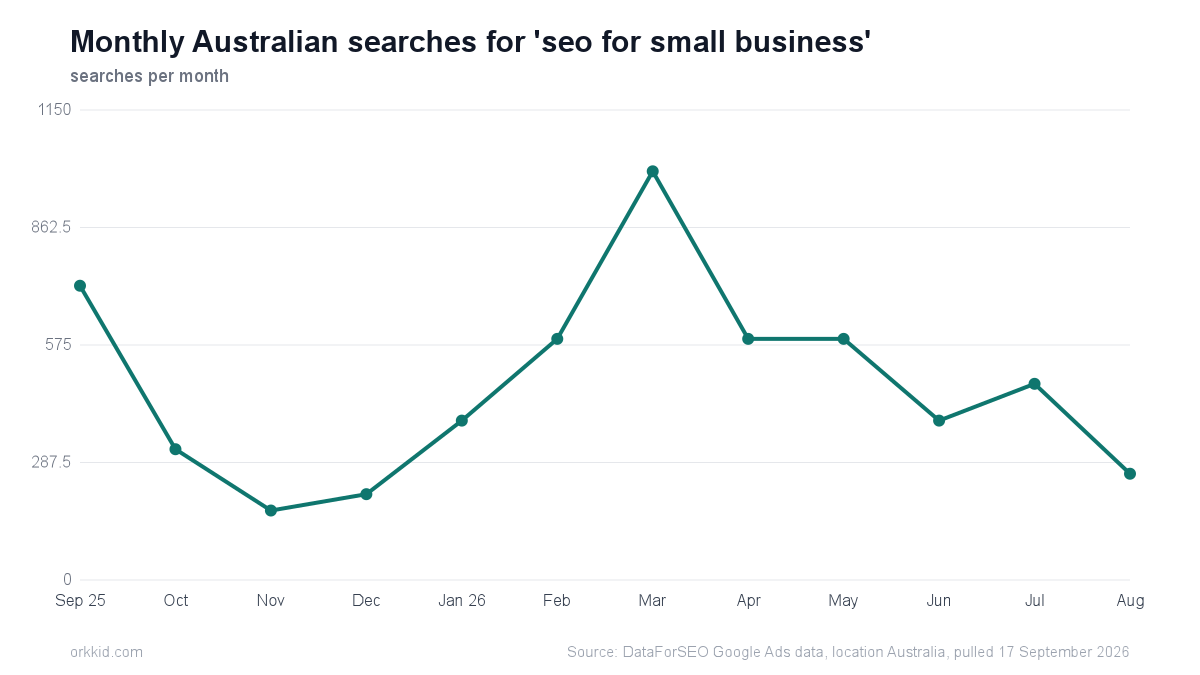
- Search demand for this topic peaks in March, so the useful time to start is December or January, not the week you notice the phone is quiet.
What SEO does for a small business in Australia, and what it will not do in 90 days
It gets you found, and increasingly named, for "service plus suburb" searches by people in your area who are ready to buy. It will not put you above a national brand for a one-word head term inside 90 days, and nobody credible will tell you otherwise. Google's guidance on hiring an SEO says it plainly: "No one can guarantee a #1 ranking on Google."
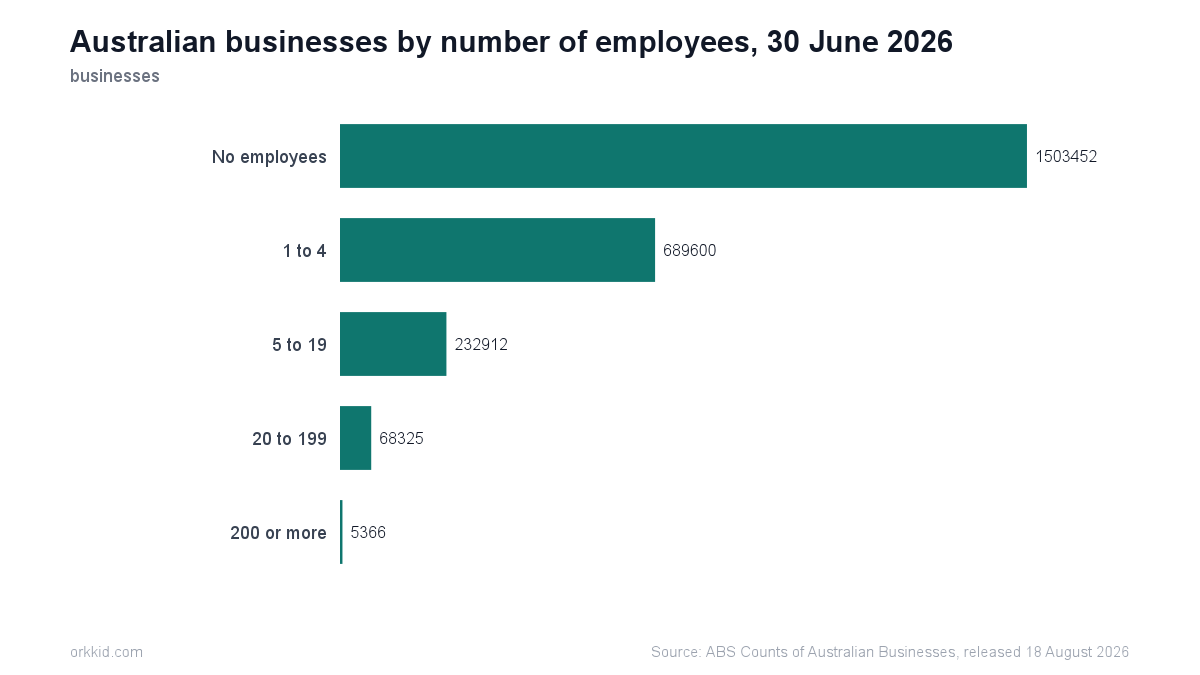
The reason that trade-off works in your favour is the shape of Australian business. The ABS counted 2,814,778 actively trading businesses at 30 June 2026, and 1,503,452 of them (53.4%) have no employees at all. Another 689,600 have one to four. Your competition for "electrician Coburg" is not a national brand with a content team. It is six other operators who have never opened Search Console.
There is a second results page now, and most small businesses have not looked at it. When someone asks ChatGPT or Google's AI Overviews who to call, a name comes back, and it is usually not yours. We tested 151 top-rated tradies pulled from Google Maps across 20 city and trade combinations: only 24 were named by AI, 15.9%. Sydney plumbers and electricians scored zero out of 16. Being highly rated is not the same thing as being recommended, and that gap is where the next few years of small business SEO gets decided.
The 90-day small business SEO plan, week by week
Here is the whole plan: 12 weeks, 40 hours, one main job per week with a test that tells you it is finished. Do the weeks in order. The foundations in weeks 1 and 2 are what make weeks 5 to 12 worth doing at all.
| Week | The job | Hours | Tool | Done when |
|---|---|---|---|---|
| 1 | Claim and verify your Google Business Profile | 3 | Google's claim guide | Listing verified, category set, hours filled |
| 2 | Search Console, sitemap and an AI baseline | 3 | Search Console | Sitemap submitted, AI answer recorded |
| 3 | Make your name, address and phone identical everywhere | 4 | Your existing listings | Same NAP on every profile you own |
| 4 | Build the keyword list from your own data | 3 | Search Console queries, autocomplete | Ten "service plus suburb" phrases written down |
| 5 | Write service page one | 4 | Your website CMS | Page live, one service, one clear next step |
| 6 | Write service page two, add ten job photos | 4 | Phone camera | Page live, photos captioned with suburb and job |
| 7 | Set up the review routine | 3 | Review link plus an SMS template | Every finished job triggers one ask |
| 8 | Mobile speed check and the three worst fixes | 3 | PageSpeed Insights | Mobile score recorded, three fixes shipped |
| 9 | Add LocalBusiness schema | 3 | Schema generator | Markup live and validating |
| 10 | Ten Australian directory listings | 4 | Your NAP details | Ten listings live and identical |
| 11 | Service page three and internal links | 4 | Your website CMS | Every service page linked from the menu |
| 12 | Measure, then decide | 2 | Search Console, ROI calculator | Impressions, clicks and calls compared to week 1 |
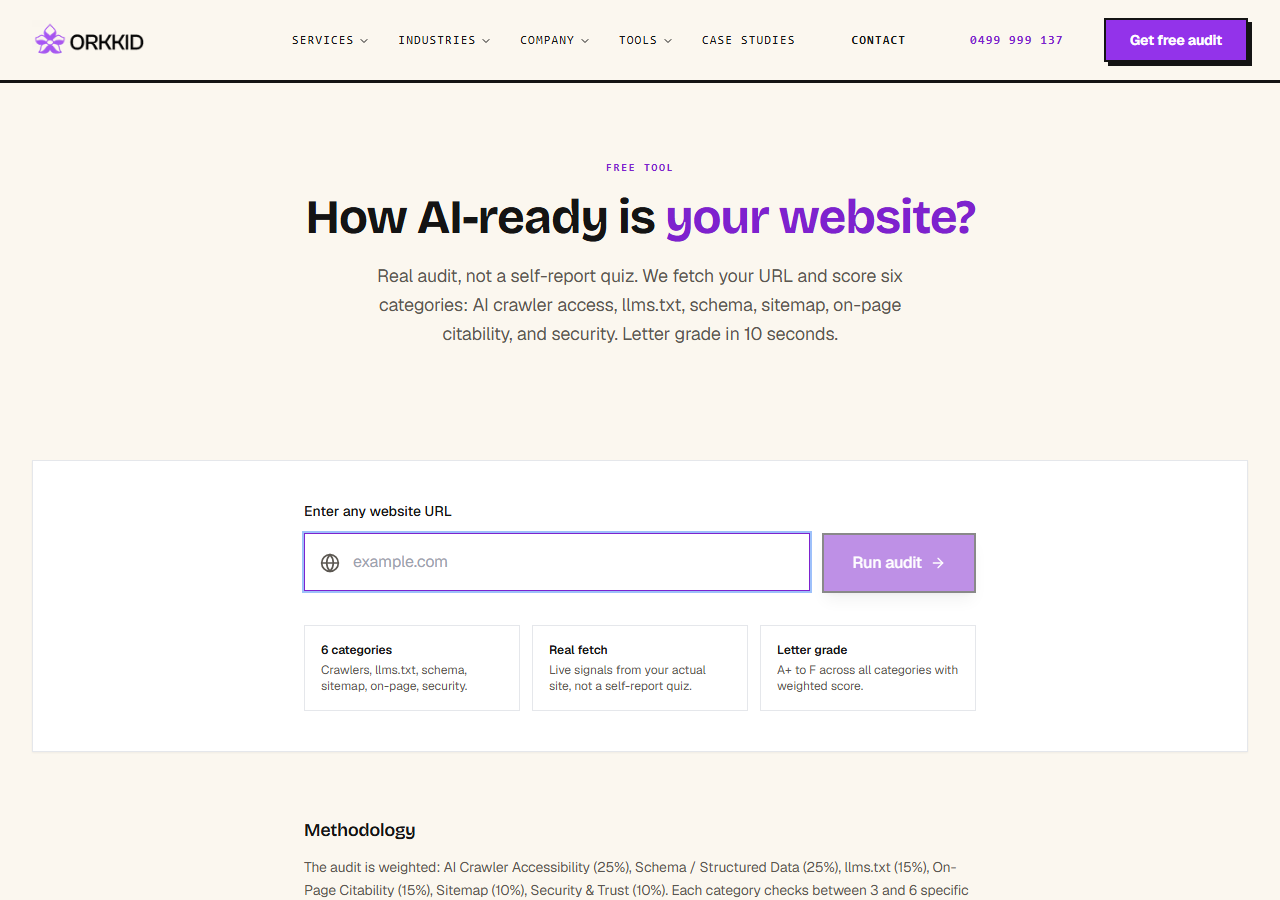
Weeks 1 to 2 are the only ones with a deadline. Your Google Business Profile is the highest-return asset a local business owns, and verification can take days to arrive by post, so start it before anything else. In week 2, before you change a thing, record your baseline: search your top three phrases, screenshot where you sit, and run the free AI visibility audit so you have a dated record of whether AI names you. Everything you do for the next ten weeks is measured against that record.
Week 3 is the boring one everything else rests on. NAP consistency means your business name, address and phone number appear in exactly the same form on your website, your Google profile, Hipages, Oneflare, your Facebook page and every directory you have ever filled in. Unit 3/14 and 3/14 and Suite 3, 14 read as three different businesses to a machine. Fix the format once, write it in a note, and paste it from then on.
Weeks 5, 6 and 11 are the writing weeks. One page per service, and one page per main suburb if you cover more than one. A page that says "we replace hot water systems in Preston", explains what it costs to think about, what happens on the day, and who did the last ten, beats a services page that lists fourteen things in bullet form. Google's SEO Starter Guide is the reference for the mechanics: descriptive URLs, one clear title per page, images with real file names.
Week 9 is where you tell machines what you are. LocalBusiness structured data carries your name, address, telephone, opening hours, price range and geographic details in a form search engines and AI answer systems read directly, instead of inferring it from your footer.
Two neighbours before you start. If you trade in Victoria, the Victorian version of this guide goes deeper on Melbourne suburb intent and regional towns, while this plan is national. If you are a tradie, the trade guide covers emergency searches and job-type pages other small businesses do not need.
One note on timing. Demand here is seasonal: searches for "seo for small business" peaked at 1,000 a month in March 2026 and bottomed at 170 in November 2025. Everyone plans at once, so the businesses that started in December have pages indexed by the time the March crowd opens a blank page.
When a customer asks ChatGPT who to call, whose name does AI give?
One report: who AI recommends in your suburbs right now, what they have that you don't, and the fastest path to being the name it gives. Sent within 72 hours.
Run my free audit →How many hours a week small business SEO takes
Three to four hours a week for the first 12 weeks, then one to two hours a week to keep it alive. The plan above totals 40 hours, and the heaviest weeks are the writing weeks at four hours each. After week 12 the recurring work is a review ask on every job, one page or post a month, and fifteen minutes in Search Console.
The useful comparison is what agencies actually publish for the same work. These figures come from Australian agency pricing pages in September 2026, with the implied hourly rate worked out from their own numbers.
| Published package | Hours a month | Price a month | Implied hourly rate |
|---|---|---|---|
| Entry local retainer | 5.5 | $1,200 | About $218 |
| Mid retainer | 16 | $2,999 | About $187 |
| Volume retainer | Up to 30 | From $2,500 | About $83 |
| Low-competition tier | 3 to 10 | $450 to $1,500 | $45 to $500 |
Two things fall out of that table. Professional SEO on a small local account is often 5 to 16 hours a month, not the full-time effort owners imagine, which is why three to four hours a week is competitive at the start. And paid hours are not cheap hours: when a provider quotes a monthly fee, ask how many hours it buys, then divide. A retainer that will not answer is selling you a label.
The DIY-or-hire rule, in dollars
Multiply your own billable rate by 15 hours a month, which is what this plan costs in time. If that number is bigger than the cheapest credible local retainer, hiring is the cheaper option, and for most Australian owners the crossover sits around $100 an hour.
The maths fits on the back of an invoice:
Your billable rate x 3.5 hours a week x 4.3 weeks = what the plan costs you each month.
Local SEO retainers in Australia start at roughly $750 to $1,500 a month at the starter end, which we break down properly in our guide to what SEO costs in Australia. That post is the price benchmark; this one uses prices only to answer the hire question.
| Example owner | Billable rate | Cost of 15 hours | Starter retainer | What the maths says |
|---|---|---|---|---|
| Sole trader plumber | $110 | $1,650 | $750 to $1,500 | Hire once the foundations are done |
| Two-van cleaning business | $65 | $975 | $750 to $1,500 | Line ball, keep doing it yourself |
| Regional accountant | $220 | $3,300 | $750 to $1,500 | Hire from week one |
Plug in your own rate, and read the result honestly, because the arithmetic only holds if those hours would otherwise be billed. If you do the plan on Sunday nights and your diary has gaps anyway, your real cost is close to zero and doing it yourself wins easily. If you would turn away jobs to write a service page, it never made sense.
There is a third case the table misses: you have the time and the money, and you still will not do it. Twelve weeks is long enough for most owners to stop at week five. If you have abandoned a plan like this before, hire, or cut it back to weeks 1, 2, 5 and 7 and accept a smaller result. Our ROI calculator prices a few extra jobs a month against either option.
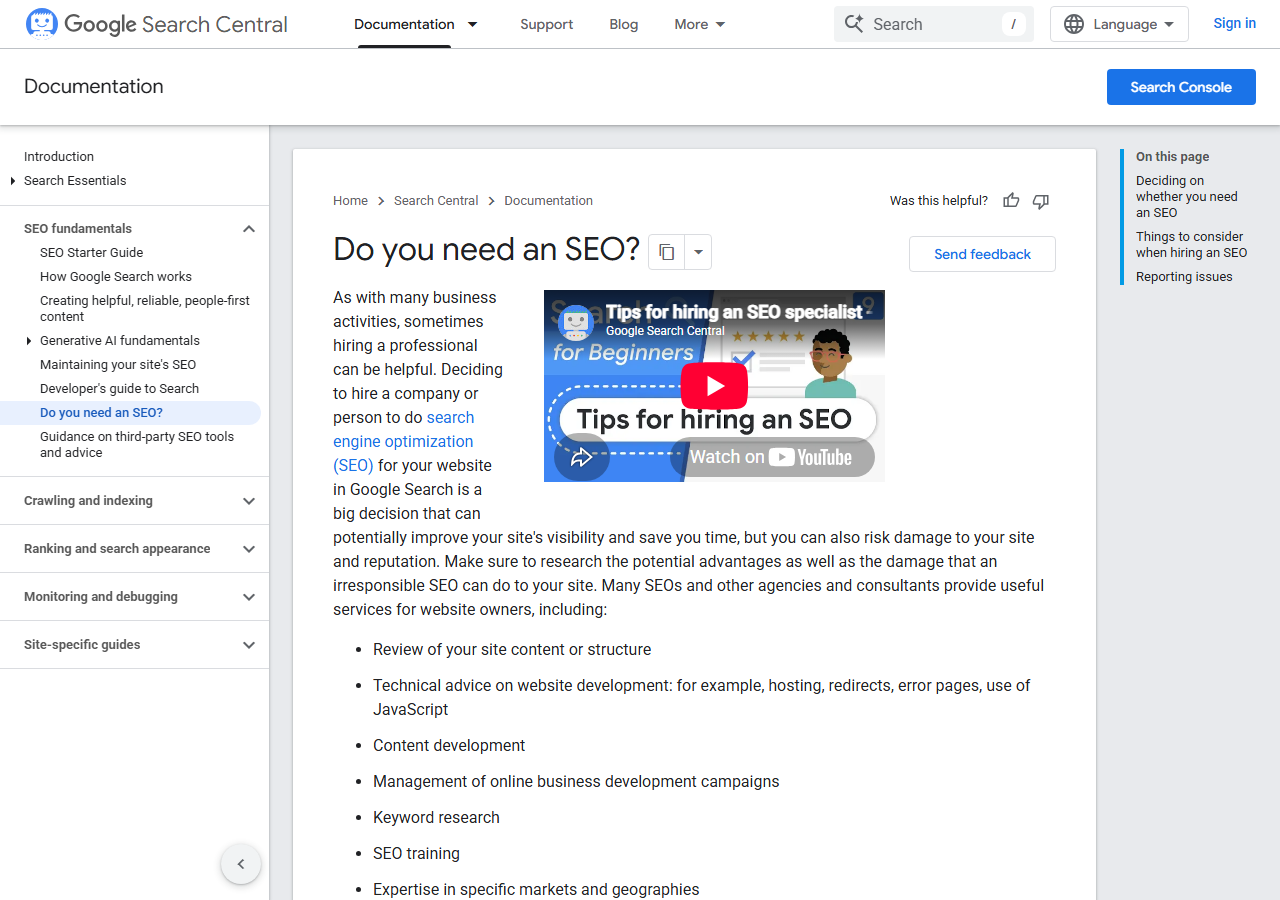
Google recommends that small local businesses read the starter guide and try it first, and says that when you do hire, "the earlier, the better", especially around a redesign or a launch. It also lists the questions to ask: examples of previous work, whether they follow Google Search Essentials, expected results and timeframe, experience in your industry and city, and how they will communicate.
Five things Australian small businesses get wrong
These are the patterns visible on the pages currently ranking for this search, and in most accounts we look at.
- Chasing links as a tactic. One page on the first results page opens with "get as many links to your website" as tip number one. Google's spam policies define link spam as creating links primarily to manipulate rankings, including buying them and generating them automatically. Links from your industry association, your suppliers and local sponsorships are fine. Paid packages of 50 links are a risk you cannot undo quickly.
- One services page listing everything. If you do hot water, drainage and gas fitting, that is three pages. A single page mentioning all three ranks for none of them.
- Reviews collected by accident. Two reviews in eighteen months is not a review profile. One text message per finished job, sent the same day, is the whole system. If you run an AHPRA-regulated practice such as dental or physiotherapy, reviews can sit on your Google profile, but testimonials about clinical care cannot be used in your own advertising, so do not paste them onto your website.
- No Search Console. Without it you are guessing at which phrases you already appear for. It is the cheapest keyword research available and the only data about your site nobody else can see.
- Expecting results in 30 days. Google's starter guide says "Some changes might take effect in a few hours, others could take several months". A local business with a verified profile and three service pages can see movement inside a quarter. A brand new domain in a capital city usually cannot.
What the first results look like
Impressions move first, then positions, then calls, usually in that order and usually with a long flat stretch at the start. On our own site, impressions ran at roughly 15 a day in April 2026 and reached 500 to 900 a day by July 2026, on a domain that had only been live since around May. For most of that period nothing ranked on page one at all: the first two posts to get there landed at average positions 5.5 and 4.2, months after they were published.
Use the shape, not the numbers: a Melbourne plumber and an agency blog are different games. Here is where to look in weeks 4, 8 and 12:
- Week 4: impressions in Search Console are rising, even if clicks are not. Pages are being seen.
- Week 8: a handful of "service plus suburb" phrases appear with average positions in the teens or twenties. That is normal, and it is progress.
- Week 12: positions tighten into single digits on your least competitive phrases, and the phone starts carrying calls you cannot trace to anything. Ask every caller how they found you, and write it down.
If nothing has moved in Search Console by week 12, the problem is usually technical or the pages are too thin, rarely that SEO does not work for your trade. That is the point to get a second opinion rather than doubling the hours.
What to do this week
Ordered by return on the hour. If you only get through the first three, you have still done the most valuable part.
- Claim or verify your Google Business Profile (60 to 90 minutes, plus waiting). Set the primary category precisely, fill your hours, add your service area. This one action outperforms everything else on the list for a local business.
- Record your baseline (30 minutes). Search your top three phrases in an incognito window, screenshot the results, then run the AI visibility audit and save what comes back. You cannot prove progress you never measured.
- Set up Search Console and submit your sitemap (30 minutes). Free, permanent, and the only honest source of data about your own rankings.
- Standardise your NAP (45 minutes). Write your business name, address and phone in one note, in one format, then fix every listing you can find to match it.
- Write the first service page (2 to 3 hours). Pick your most profitable service, not your most common one. One page, one service, one suburb in the title, one clear way to get in touch.
- Do the arithmetic (10 minutes). Your billable rate times 15. Compare it to $750 to $1,500. That is your answer on whether week 13 belongs to you or to someone else.
84% of top-rated service businesses are invisible to AI. Are you?
We tested 151 top-rated Australian tradies and 84% were never named by ChatGPT. Check your business before your competitor checks theirs.
Tested: 151 top-rated Australian tradies · 15.9% named by ChatGPT · Q3 2026 study
Run my free audit →FAQ
Is SEO worth it for a small business?
Usually yes for a local service business, because the competition is other small operators rather than national brands, and because the traffic is people ready to buy now. The test is whether people search for what you sell in your area. Check Search Console or Google autocomplete first. If nobody searches for it locally, put the money into referrals instead.
How do I do SEO for a small business?
In this order: verify your Google Business Profile, set up Search Console, make your name, address and phone identical everywhere, build a keyword list from your own search data, write one page per service, then collect reviews on a routine. Directories, schema and speed come after that. Doing them out of order is the most common reason three months produces nothing.
Can I do SEO myself for free?
Yes, for the first 90 days almost entirely. Google Business Profile, Search Console, PageSpeed Insights, schema generators and Google autocomplete are all free, and between them they cover every task in the plan above. What you pay is time, about 40 hours over 12 weeks. Paid tools earn their place later, when you are tracking dozens of phrases instead of ten.
How long before a small business sees SEO results in Australia?
Expect impressions to move within four to eight weeks and rankings to firm up between three and six months, faster in a regional town and slower in a capital city. Google's own documentation says changes can take anywhere from a few hours to several months. Anyone promising page one in 30 days is either lucky, targeting phrases nobody searches for, or both.
When should a small business stop doing SEO itself and hire someone?
When your billable rate times 15 hours a month is more than the starter retainer range of $750 to $1,500, or when you have abandoned the plan once already. For most owners that crossover sits around $100 an hour. The other trigger is a website rebuild, because Google recommends bringing someone in before a redesign rather than after it.