

A consultant advises, a freelancer executes, an agency does both with a team. This page gives you a decision matrix by business size and budget, the published Australian rates for all three, a 20 minute interview script, and the six contract terms to insist on before you sign anything.
An SEO consultant advises, a freelancer executes, and an agency does both with a team. Which one you should hire comes down to two questions: what you can spend every month, and whether anybody inside your business will own the work once it lands.
Every three way comparison on page one for this query was written by one of the three options, and in every one of them the author's own column wins. So, the disclosure up front: Orkkid is an agency. We sell SEO and AI SEO services, so read the matrix below looking for the rows where we recommend against hiring an agency. They are there, because for plenty of businesses an agency is the wrong first hire.
What this page adds: a decision matrix keyed to business size and budget, published Australian rates for all four options side by side (freelancer, consultant, agency, in house), a 20 minute interview script built on Google's own questions, and six contract clauses to insist on.
TL;DR
- A consultant diagnoses and directs, a freelancer executes a defined scope, an agency does both with a team, an in house hire owns it from inside. Pick by budget band and by who will own the relationship.
- Published Australian anchors, September 2026: consultants from $650 a month, freelancer day rates $600 to $1,500, agency entry prices $800 to $2,990 with a median of $2,000.
- Under $1,000 a month a retainer buys two or three hours of real work. Buy a paid audit and a defined freelance scope instead.
- Google publishes seven questions to ask any SEO and states plainly that "No one can guarantee a #1 ranking on Google". Promising position one is also an ACCC substantiation problem for the seller.
- Only 9% of the 54 Australian agencies we checked commit to no lock in. Ask for 30 day termination in writing before you ask about price.
- Accounts stay in your name, and per Google, "You should never have to link to an SEO".
What a consultant, a freelancer and an agency each actually do
The difference is not seniority or price, it is where the work happens. A consultant hands you a diagnosis and a plan, and someone else does the work. A freelancer takes a defined scope and does it. An agency takes the thinking and the doing, with several specialists on your account. An in house hire does all of it from inside, and manages the suppliers you still need.
| Option | What they actually do | How they bill | Worst at |
|---|---|---|---|
| SEO consultant | Audit, strategy, priorities, reviewing work others do | Hourly, day rate, small monthly fee | Delivery. You still need hands to do the work |
| SEO freelancer | Executes a scope: content, technical fixes, profile work, links | Hourly, per project, small retainer | Cover. Illness, holidays and bigger clients push you down the list |
| SEO agency | Diagnoses and executes with a team and a process | Monthly retainer, usually 3 to 12 months | Seniority drift. You meet the lead, a junior does the work |
| In house hire | Owns search inside the business and manages suppliers | Salary plus super, tools, management time | Breadth. One person rarely covers technical, content, links and AI |
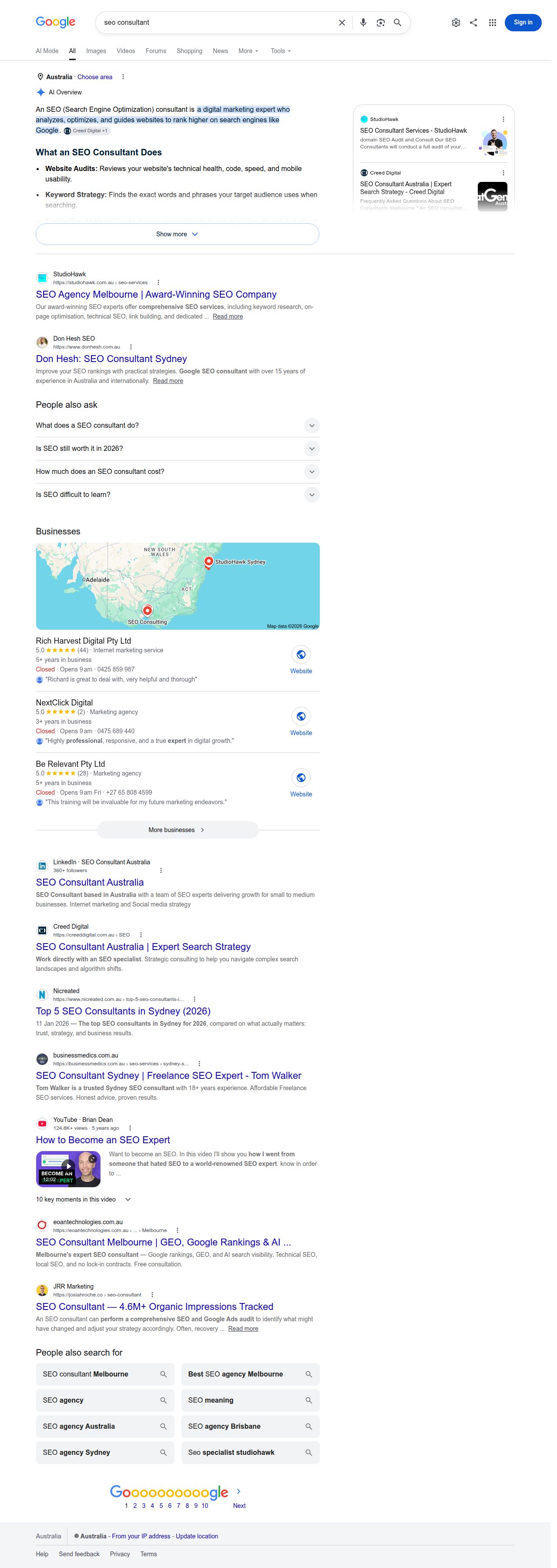
Two details from that results page are worth knowing before you start calling people. One of the three businesses in the local pack for "seo consultant" on 17 September 2026 was a South African company with a +27 phone number, sitting inside the Australian local pack, so proximity results for this query are not a shortlist. And roughly half the demand is not buyers: the term averages 1,600 searches a month in Australia, spikes to 4,400 in March and 2,900 in September, then falls to 390 in August. Those are hiring season spikes driven by job seekers and recruiters.
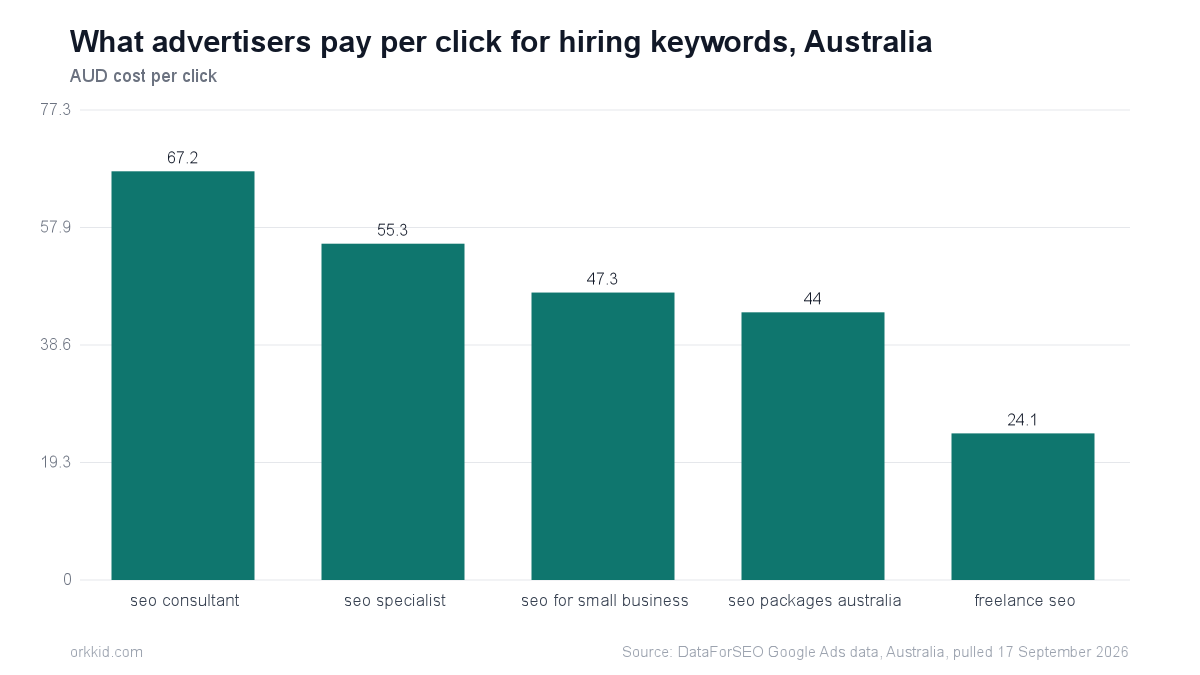
That chart explains why nearly every page you are about to read is a pitch. Australian advertisers pay $67.18 for one click on "seo consultant" and $55.28 on "seo specialist" (DataForSEO, September 2026). At those prices, nobody publishes a neutral comparison out of goodwill.
What each option costs in Australia
Here are the published anchors, each with a source and a date, so you can hold a quote against them. Everything below was read on 17 September 2026 unless the date says otherwise. None of it is our price list, and we do not publish ours in blog posts.
| Option | Published Australian anchors | Usual billing |
|---|---|---|
| Solo consultant | From "$650/month" advertised; consulting $120 to $300+ per hour | Hourly or day rate |
| Freelancer | $600 to $1,500 a day, $2,500 to $8,000 a month (Kindred Talent, June 2026) | Day rate or project |
| Offshore marketplace | "$15 to $35 per hour" (Google AI Overview citing Upwork, second hand) | Hourly |
| Agency | Entry $800 to $2,990, median $2,000 across 54 agencies; advertised "from $1,900 + GST/month" and "$1,500 to $5,000+/month" | Monthly retainer |
| In house | No verified Australian salary figure. Budget salary, super, tools, management time | Salary |
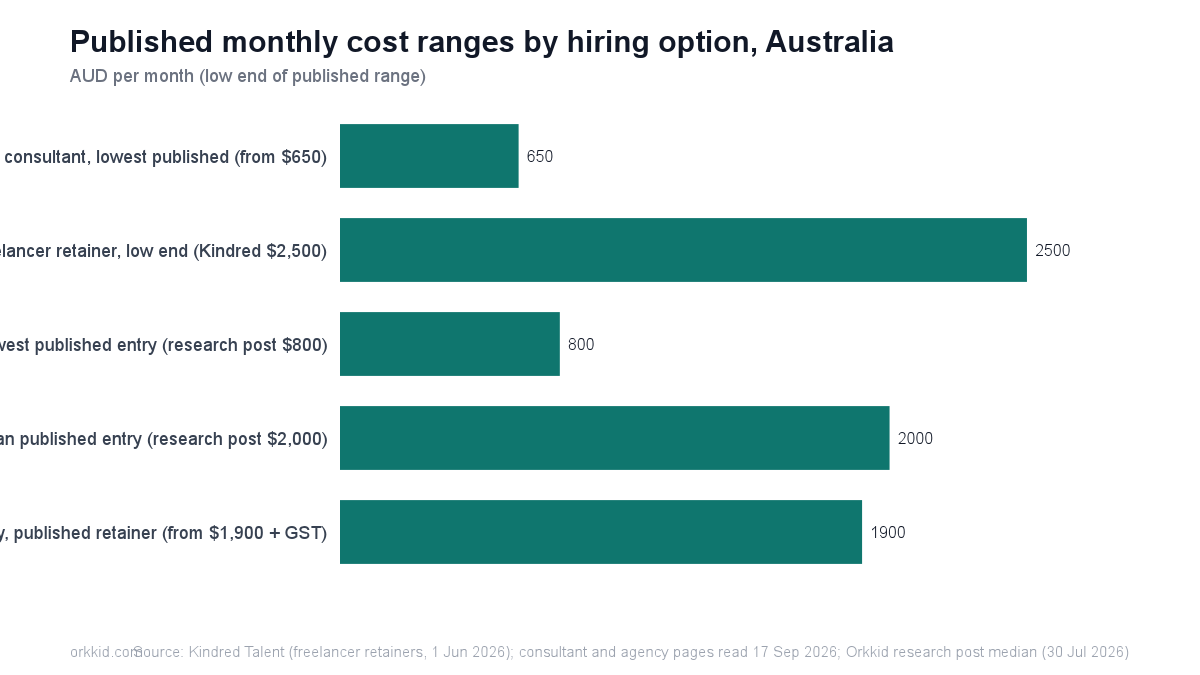
Three things that table does not say out loud. Agency prices are mostly invisible: only 5 of the 54 agencies in our pricing research published a number at all. Quoted agency figures usually exclude GST, so a "$1,900" retainer is $2,090 out of your account. And a day rate is not a cheaper retainer: $1,200 a month of freelance time at $800 a day is a day and a half, which buys execution, not strategy plus execution. Fixed price projects sit apart from all of it, with Australian pages advertising "$3,500 to $8,000" for a defined build.
For the full price benchmark rather than the three way comparison, how much SEO costs in Australia covers the whole range. This page only compares what the three hiring options publish.
When a customer asks ChatGPT who to call, whose name does AI give?
We tested 151 top-rated Australian tradies and 84% were never named by ChatGPT. Check your business before your competitor checks theirs.
Run my free audit →The decision matrix: which option fits your business size and budget
Pick the row that matches your headcount and your monthly budget, not the row that matches your ambition. Budget rarely decides this on its own. What decides it is whether anyone in your business has two hours a week to own the relationship.
| Your business | Monthly budget | Best first hire | Why | What to avoid |
|---|---|---|---|---|
| Sole trader, one van or one room | Under $1,000 | Paid audit, then a freelancer on defined tasks | You need a fixed list done properly, not a strategy deck | A retainer. At $500 a month you are buying two hours of real work |
| 2 to 10 staff, one location | $1,000 to $3,000 | Consultant for the plan, freelancer to execute, or a small agency | Splitting thinking from doing costs less and keeps the plan honest | A 12 month lock in signed before you have seen a single report |
| 10 to 50 staff, several service lines | $3,000 to $8,000 | Agency with a named team you actually meet | Content volume plus technical plus links is more than one person | Paying for seniority you never speak to after the pitch |
| Multi location or national | $8,000+ | Agency plus one internal owner of the relationship | Someone inside has to hold the agency to the plan | One supplier doing paid, SEO, social and web with no named specialist |
| In house team already exists | Any | Consultant on a day rate | Your team can execute, they need direction and a second opinion | A full retainer that duplicates what your team already does |
What each option is worst at matters more than what it is best at, because that is the part you live with. Choose the failure mode you can manage.
One Australian quirk worth knowing: agency supply is concentrated. Of those 54 agencies, 20 were headquartered in Melbourne and 13 in Sydney, so buyers in other states are buying remotely anyway and should stop treating "local" as a filter. If you have already settled on an agency and are choosing inside one state, our Victorian agency guide covers state level selection; this page is about which kind of supplier to hire, nationally.
The 20 minute interview script
Ask the same seven questions of everyone, then three more that are specific to the option in front of you. The seven shared questions are Google's, not ours, from its guidance on whether you need an SEO.
| Ask everyone | The answer that should worry you |
|---|---|
| Can I see examples of your previous work? | Logos with no URLs, or "confidential" for every single client |
| Do you follow Google Search Essentials? | Hesitation, or a pitch about "loopholes" and what Google does not tell you |
| What results do you expect, by when, and how will we measure them? | A guaranteed position or date. Google's line: "No one can guarantee a #1 ranking on Google" |
| Do you have experience in my industry, my country and my city? | An Australian business handed a case study from another market |
| How long have you been in business? | Evasion, or a brand new entity claiming 15 years of experience |
| How will we communicate, and will you share every change and why? | Changes pushed without notice, or reporting that is only a dashboard link |
| Why are you interested in my business? | A pitch that would work for any business in any industry |
Google also names the pitches that should end the call: a claimed "special relationship with Google" or "priority submit", unsolicited email offering SEO, and any suggestion you should link to your SEO. It is blunt about the downside too, warning that unethical tactics can lead to "removal of your site from our index".
Coursera's consultant guide, updated 28 March 2026, adds six worth stealing: which tactics they use, how often they check in, their expected timeline, whether they work with your competitors, whether their practices are white hat, and how they report.
Three extra for a freelancer
- How many clients do you have right now, and what happens to my work if you are sick for a fortnight?
- Do you subcontract any of this, and to whom?
- Which parts of this scope are outside your skill set, and who should I hire for those?
Three extra for a consultant
- Who executes your recommendations, and will you review their work?
- What does the deliverable look like, page by page, and who owns it afterwards?
- What happens in month two, and will I still need you in month three?
Three extra for an agency
- Who does the actual work on my account, what is their name, and how many other accounts do they carry?
- Do you work with any of my direct competitors in my service area?
- Show me last month's report for a client in a similar business, redacted.
One tell works on all three: ask what they would remove from your site. Anyone who only adds things has not looked at it. For the vetting round after you have settled on a type of supplier, our 10 questions to ask before hiring an SEO agency goes deeper on references and reporting; this page decides which kind of supplier to vet in the first place.
→ Quick check: when a customer asks ChatGPT who to call, is your business the one AI names? Find out free. Run my free audit.
Six contract terms to insist on
These six clauses cost nothing to ask for, and the reaction to the request tells you more than the answer does. Send them before the proposal, not after.
| Clause | What it says | Why it matters |
|---|---|---|
| Accounts in your name | Search Console, Analytics, Google Business Profile and hosting stay on your email | You keep the history when you leave. Search Console verification follows the property, not the agency |
| Content and asset ownership | Everything produced is yours on payment, drafts and raw files included | Otherwise pages come down at the end of a relationship |
| 30 day termination for convenience | Either side ends it on 30 days notice after any minimum term | Only 9% of the 54 agencies we checked commit to no lock in |
| No links back to the supplier | No footer link, badge or mention as a condition of the work | Google: "You should never have to link to an SEO" |
| Disclosed subcontracting | Outsourced work is named, and offshore execution is disclosed | You are entitled to know who writes in your name |
| Itemised monthly reporting | What was done, what changed, what is next, in writing | A dashboard is not a report. How to read an SEO report covers what belongs in one |
One more term nobody offers and everybody should: a written list of what will not be done. Suppliers who publish their exclusions are easier to trust than suppliers who imply everything is included.
On guarantees, be careful in both directions. A promised ranking position is a claim the seller has to substantiate under the ACCC rules on false or misleading claims, and nobody can substantiate a promise about an algorithm they do not control. A guarantee about the supplier's own conduct and deliverables is a different thing, and a fair one. Check the proposal against Google's spam policies too: paid links and mass generated pages are link spam and scaled content abuse by Google's definitions, and your domain wears the consequence, not theirs.
How to check they can get you into AI answers
Ask for a baseline before the work starts: a fixed list of prompts run across ChatGPT, Perplexity and Google AI Overviews, with a record of which businesses get named. If a supplier cannot produce that inside a week, they are guessing about answer engine optimisation and charging you for the guess.
This is a real gap. When we tested 151 top rated Australian tradies pulled from Google Maps, only 24 of them (15.9%) were named by AI when we asked for a recommendation, and Sydney plumbers and electricians scored 0 out of 16. Being the highest rated business in your suburb does not get you named. The method and the full numbers are in our AI visibility study.
Do this before the call, so you grade their answer against something real:
- Build a 15 prompt panel with the prompt panel generator, using the words your customers would actually type.
- Run the AI visibility audit on your own domain and keep the result.
- Ask each candidate what they would change first, and why, based on that result.
The follow up is about evidence, not tactics: how will you show me this worked in 90 days? Good answers re run the same prompt panel and build E-E-A-T signals like named authors and verifiable credentials. Weak answers say "AI optimised content" and nothing you can measure.
When a freelancer is the right call
A freelancer is the right call when you already know what needs doing and you need hands, not a diagnosis. Australian rates sit at $600 to $1,500 a day, or $2,500 to $8,000 a month retained, according to recruiter Kindred Talent (1 June 2026). Offshore marketplace rates are a fraction of that, and so is the time anyone spends on you.
Use a freelancer for a defined, finishable job: the technical fix list from an audit, 12 service pages written, schema implemented, a Google Business Profile rebuilt, a migration checked. Pay per project where you can, so the scope has an end date on it. Do not make a freelancer your only supplier if search is your main source of enquiries and nobody internal owns it. One person with no cover is a single point of failure on the channel that feeds you.
One warning about searching for one: results for "freelance seo" in Australia are dominated by job boards, because most people typing it want freelance work rather than a freelancer. Build your shortlist from referrals and past work instead.
What to do this week
- Write down your budget band and your owner (10 minutes). One number, one name. If the name is blank, you need a supplier who reports without being chased, which rules out most freelancers.
- Run your own baseline (20 minutes). A free audit plus the prompt panel, saved as a PDF, so every candidate is graded from the same start.
- Shortlist three, one per option (60 minutes). Comparing three agencies teaches you nothing about which type fits.
- Run the script on each (1 hour). Same seven questions, then the three for their type. Score the worrying answers, not the confident ones.
- Send the six clauses before the proposal (5 minutes). Whoever pushes back on accounts in your name or 30 day termination has told you everything.
- Sign a 90 day trial, not a year (15 minutes). Put the review date in your calendar the day you sign.
Be the business AI recommends
Most service businesses never find out they lost the job, because AI answered before the customer ever searched. Our free AI SEO audit shows you exactly where you stand today.
Tested: 151 top-rated Australian tradies · 15.9% named by ChatGPT · Q3 2026 study
Run my free audit →FAQ
What does an SEO consultant do?
An SEO consultant diagnoses and directs rather than delivers. The work is usually an audit of your site and results, a keyword and content plan, competitor analysis, and review of whoever executes. Most bill hourly or by the day, commonly $120 to $300+ an hour in Australia. You still need someone to do the work they recommend, which is the part buyers miss when comparing a consultant fee to a retainer.
How much does an SEO consultant cost in Australia?
Published Australian rates as of September 2026 start around $650 a month for a solo consultant's smallest package, with hourly consulting commonly $120 to $300+ and freelance day rates of $600 to $1,500 according to recruiter Kindred Talent. Agency retainers advertised publicly start around $1,900 plus GST, against a median entry price of $2,000 across the 54 agencies we checked.
How much do freelancers charge for SEO?
Australian freelance SEO specialists charge roughly $600 to $1,500 a day, or $2,500 to $8,000 a month on retainer, based on recruiter data published in June 2026. Global marketplaces are far cheaper, with $15 to $35 an hour quoted by Google's AI Overview from Upwork, although that figure is second hand. Project pricing is safer than hourly for a first job, because the scope has an end.
Should a small business hire an SEO consultant or an agency?
Under about $3,000 a month, hire a consultant for the plan and a freelancer to execute it. Above that, an agency usually wins, because content, technical work and links together exceed what one person delivers. The deciding factor is not money, it is whether someone inside your business will own the relationship. If nobody will, buy the team that reports without being chased.
What is the difference between an SEO specialist and an SEO consultant?
The titles overlap, but in practice a specialist is a doer and a consultant is an adviser. Specialists are often employees or contractors executing a defined scope inside a team. Consultants are independent and charge by the hour or the day. If someone calls themselves a consultant, ask who executes their recommendations. If they say specialist, ask who sets the strategy.
Is SEO replaced by AI?
No, but the destination has changed. People still search, and AI answers are assembled from web pages, profiles and reviews somebody had to earn a place in. What has shifted is that ranking is no longer the same as being named: in our test of 151 top rated Australian tradies, only 15.9% were named by an AI assistant asked for a recommendation. Hire for both.